The New Kimi K2.7 Model is VERY Impressive

Video thumbnail: The New Kimi K2.7 Model is VERY Impressive
Jun 18, 202646s video lengthCole Medin

The Signal

Moonshot has released Kimi K 2.7, an open-weights coding model marketed as its most powerful to date. The company claims the model beats its predecessor, K 2.6, by double digits across three benchmarks while utilizing 30% fewer reasoning tokens. It is an immediate open play, positioning itself as a potential alternative to closed giants like Claude and GPT.

The Case

Access and Performance

  • The Kimi K 2.7 model is available now for public use through the Kimi CLI and Kimi code platforms.0:10
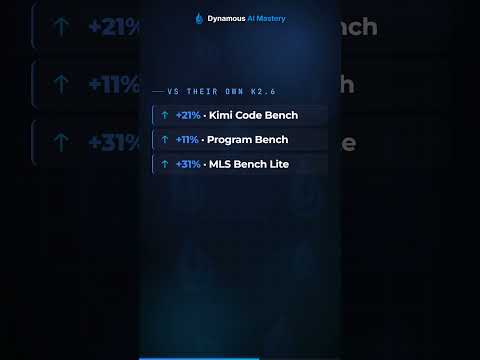
  • Moonshot reports significant performance gains over their K 2.6 baseline: 21% better on Kimi code bench, 11% on program bench, and 31% on MLS bench light.
  • The most load-bearing specific is the claim that these gains are achieved with 30% fewer reasoning tokens, which the narrator frames as a reduction in unnecessary computation.0:28

Future Roadmap

  • A new "six-time speed mode" is announced as forthcoming, though Moonshot provided no release date or technical specifications for how this speed increase will be achieved.

Market Positioning

  • The release concludes with an open question to users: whether this model performs well enough to replace closed competitors like OpenAI's GPT or Anthropic's Claude. These benchmark numbers remain promotional assertions from the company and have yet to be independently verified in real-world environments.

The 1 Minute Signal Take

Because all performance data comes directly from the developer, verify these efficiency gains on your own specific workflows before migrating from established providers. The model is accessible enough to test immediately, making independent evaluation the only way to settle the question of its actual competitiveness against closed industry standards.

Pro Analysis

Why it matters

This release signals a aggressive effort by Moonshot to capture the developer market by offering open-weights alternatives that compete directly with closed-source incumbents. It challenges the assumption that only massive closed models can provide elite-tier coding proficiency.

Strategic implications

If Kimi K 2.7 proves effective in real-world environments, it incentivizes developers to move away from paid proprietary APIs. Lower reasoning token usage directly translates to lower operational costs, which is highly advantageous for companies running large-scale or automated coding agents.

Evidence & Hype Audit

The content relies heavily on internal, self-reported benchmark metrics without disclosing the underlying methodology or providing independent verification. Take the efficiency claims as an engineering goal statement rather than a validated performance guarantee.

Counterarguments

Critics may point out that benchmarks, especially narrow coding benchmarks, often favor the developer's own models. Furthermore, without a mature ecosystem of third-party integrations similar to what exists for GPT or Claude, the 'migration cost' for professional development teams might outweigh the marginal performance or cost benefits.

Action Items

  • Benchmark against your current workflow using your own unit test suites.
  • Monitor GitHub or developer forums for third-party verification of the 30% reasoning-token reduction.
  • Integrate the model into a local CLI environment to test compatibility with existing project structures.
  • Prepare to re-evaluate infrastructure if the promised 'six-time' speed mode materializes, as it could alter the compute/performance trade-off entirely.

Share this

Tags