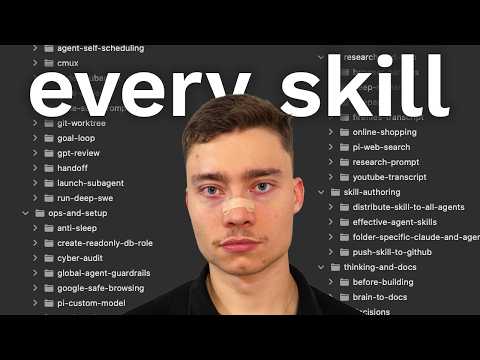
I open-sourced my Agent Skills repo (it went viral)

Video thumbnail: I open-sourced my Agent Skills repo (it went viral)
Aug 2, 202630m 52s video lengthDavid Ondrej

The Signal

David Andre, a developer with extensive experience using AI agents, has open-sourced a repository of modular 'skills' designed to act as an agent control layer. He argues that loading specific instructions on demand, rather than cluttering system prompts, is essential for scaling autonomous coding, research, and productivity tasks safely and efficiently.

The Case

Agent Control & Safety

  • Modular skills architecture: Rather than general system prompts, the repo provides specific instruction sets loaded only when needed to execute distinct tasks.3:08
  • Global guardrails: Safety is enforced through a pre-tool-call hook that programmatically blocks dangerous commands—such as recursive deletes or remote Git history rewrites—before they execute.2:01
  • Decision review: To scale code review, the 'decisions' skill prompts the agent to list only uncertain judgment calls after large refactors, allowing humans to verify logic without auditing every line of code.18:08

Scaling & Infrastructure

  • Concurrency isolation: Git worktrees are presented as the primary solution to prevent file contention when running multiple agents in parallel on the same repository.5:17
  • VPS deployment: Andre advocates for hosting agents on separate VPS instances—specifically suggesting Hostinger's KVM 2 plan—to isolate agent environments from local machines and enable persistent background execution.7:17
  • Workflow automation: The 'goal loop' skill forces agents to persist on tasks until a verifiable end state is reached, while 'setup help' maintains process state during interactive tasks that require human input.11:53

Research & Utility

  • Deep API: The speaker is building a unified, application-only API service intended to consolidate scraping, web search, memory, and email capabilities into a single key, which he asserts outperforms Perplexity and ChatGPT.26:34
  • Anti-sleep: A specialized script utilizing the macOS 'caffeinate' command is provided to keep workstations active during long-running agent processes, preventing task interruption.23:17

The 1 Minute Signal Take

This repository provides a pragmatic, systems-level approach to agent management that prioritizes programmatic safety hooks and operational isolation over simple prompt engineering. While many of the speaker's claims regarding future market dominance and benchmark superiority remain self-serving marketing assertions, the underlying architectural patterns for controlling multi-agent environments offer a concrete, actionable framework for developers.

Pro Analysis

Why It Matters

This content provides a technical bridge between experimental agent use and production-grade reliability. By codifying common failure modes (file contention, runaway commands, and oversight blindness), the speaker moves the industry closer to a standardized "agentic ops" stack that reduces technical and operational friction.

Strategic Implications

Organizations building with AI agents are currently limited by "context stuffing" and the high manual cost of verifying agent work. This modular approach suggests that the future of agent management lies in standardized, versioned capability sets (skills) rather than monolithic prompts. This shift favors developers who can design resilient control loops and infrastructure, effectively commoditizing the actual code generation while prioritizing the control layer.

Evidence & Hype Audit

This content is highly pragmatic regarding architecture but leans heavily into promotional territory regarding proprietary tools. The "Deep API" performance claims are presented as anecdotal, and the Hostinger sponsorship is overt. However, the architectural patterns (guardrails, worktrees, decision-based review) are grounded in standard engineering practices and are highly transferable regardless of the vendor-linked software.

Counterarguments

Critics might argue that programmatic guardrails introduce a "black box" risk: if the hook fails or is incorrectly configured, the developer may have a false sense of security. Furthermore, for smaller teams, the infrastructure overhead of managing multiple VPSs and worktrees might outweigh the efficiency gains, creating unnecessary complexity where a simpler, more controlled agent model would suffice.

Role-Specific Takeaways

  • Developers: Focus on the implementation of pre-tool-call hooks as a defensive programming practice.
  • Engineering Managers: Shift code review processes to focus on architectural decision-making rather than syntax verification.
  • Architects: Prioritize environment isolation (worktrees/VPS) for any system running more than five concurrent agents.

What To Do Next

  • Audit your current agents for "dangerous modes" and implement a simple shell-level command blocklist.
  • Transition your parallel agent experiments to Git worktrees to eliminate shared-file conflicts.
  • Pilot the "decision review" prompt structure to see if it reduces the time spent on your next pull request.
  • Use macOS caffeinate to stabilize your long-running agent processes before committing to more complex infrastructure.
Time saved:27m 21s

Share this

Tags

Written by: 1 Minute Signal Editorial Team