Germany’s army chief on AI, drones and the future of the tank | The Economist

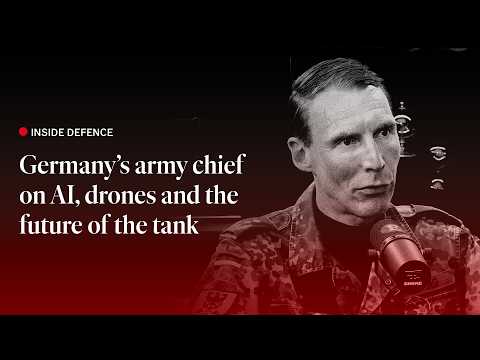
Video thumbnail: Germany’s army chief on AI, drones and the future of the tank | The Economist
Jun 25, 20266m 41s video lengthThe Economist

The Signal

Modernizing German land forces requires moving past abstract debates about legacy versus new tech in favor of five concrete capability priorities: indirect fires, counter-UAS, electromagnetic warfare, manned-unmanned teaming, and AI-enabled command. The central tension lies in whether tanks remain solitary shooters or evolve into command-and-control 'motherships,' with the speaker rejecting a fully unmanned battlefield in favor of maintaining a human decision-maker for all lethal fire.

The Case

  • The speaker identifies indirect fires—specifically artillery, loitering munitions, and deep-strike capabilities at tactical ranges of 100 to 300 kilometers—as a top-five modernization priority for Germany.0:49
  • He argues that the primary operational problem has shifted from information scarcity to information overload, necessitating the rapid development of a digital data backbone to integrate sensors from air, ground, and space.5:43
  • To address this data deluge, he maintains that AI must be used to exploit assembled information because human processing capacity is too slow for the current sensor-saturated battlefield.
  • The speaker frames the future tank as a crewed 'mothership' that coordinates unmanned ground vehicles during combat, while noting that uncrewed systems are already proven for resupply and logistics in the war in Ukraine.3:01
  • He asserts that a fully unmanned battlefield is unrealistic, maintaining that a human-in-the-loop requirement is essential for legitimate lethal action, though he offers no technical threshold to define that boundary.4:04
  • The speaker's modernization list is self-asserted and lacks comparative evidence, reflecting his specialized view as a former reconnaissance officer rather than a settled NATO-wide doctrine.2:15

The 1 Minute Signal Take

This interview captures the current push to re-engineer heavy land platforms as networked command nodes rather than archaic stand-alone assets. While the speaker provides a clear strategic direction for the German military, his dismissal of full autonomy and his focus on specific capabilities remain internal design goals rather than validated operational outcomes. Watch it if you want to understand the shift in how armored officers are currently thinking about the man-machine interface in deep combat.

Pro Analysis

Strategic Significance:

This content signals an end to the era of 'platform-centric' warfare. The strategic value is no longer in the ta...
Full analysis always available on Pro.

Time saved:4m 54s

Share this

Tags

Written by: 1 Minute Signal Editorial Team