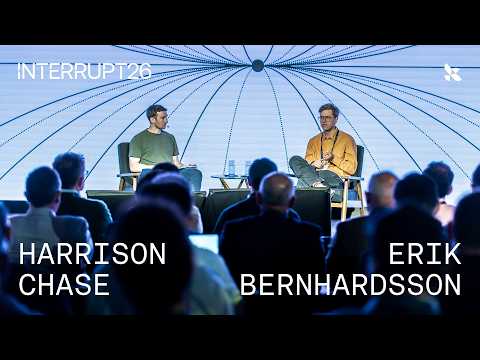
Fireside Chat with Erik Bernhardsson, Modal

Video thumbnail: Fireside Chat with Erik Bernhardsson, Modal
Nov 12, 202628m 7s video lengthLangChain

The Signal

Modal is transitioning from a general-purpose AI infrastructure provider into a product-focused platform by productizing its low-level compute and sandbox primitives. While the company grew by supporting inference for off-the-shelf models, it is now betting that ephemeral, VM-based sandboxes and high-level training products will dominate as AI-native software architectures evolve away from long-lived, monolithic agent harnesses.

The Case

Architectural Shift

  • Modal is actively replacing gVisor with full virtual machines for sandboxing, responding to customer demand for complete operating system control, Docker compatibility, and firewall-level security.6:26
  • Erik, the company’s lead spokesperson, predicts that agent harnesses will decouple from their execution environments, moving toward a model where sandboxes become ephemeral and short-lived—potentially one per tool call—rather than persisting for hours.8:04

Product Evolution

  • The company is moving up-stack by launching managed inference products like "auto endpoints" for single-tenant model deployment and batch-processing queues that offer up to 50% discounts for latency-insensitive workloads.12:47
  • A new multi-node training product featuring 128-GPU clusters with RDMA interconnects is expected to launch in the coming weeks to support sophisticated users who require more than simple inference.19:56

Operational Dynamics

  • Modal’s operating model is shifting toward a customer-embedded service motion, with its field development engineering (FDE) staff growing from three to 25 members this year to help large users architect complex workflows.21:41
  • While 95% of Modal’s customers use off-the-shelf open-source models, a small, highly sophisticated subset drives the majority of the platform's volume through reinforcement learning and heavy compute consumption.14:20

The 1 Minute Signal Take

Modal is successfully turning foundational infra primitives into packaged products because it can observe and then automate the hardest operational bottlenecks its largest customers face. The core takeaway is that the next generation of AI software will likely demand more ephemeral, low-latency infrastructure rather than the long-lived containers used in early agent prototypes.

Pro Analysis

Why it Matters

Modal represents the "pick-and-shovel" layer of the AI boom. By observing their product shifts, we gain a clear view of how the engineering reality of AI is changing: it is moving from experimental prompts to heavy, multi-node, stateful software systems that require industrial-grade infrastructure.

Strategic Implications

The migration toward full virtual machines suggests that the "serverless-lite" era of AI is insufficient for serious agentic applications. Companies that build their stacks on top of highly abstracted runtimes may soon find themselves locked out of the performance and flexibility gains enabled by full virtualization.

Evidence & Hype Audit

Erik Bernhardsson provides a grounded, product-centric view. He acknowledges the speculative nature of his market share claims and admits when he is guessing. The content is light on marketing fluff and heavy on the 'why' behind architectural decisions, making it highly trustworthy for technical audiences.

Counterarguments

A significant counterpoint exists regarding Modal’s pivot to higher-level products. By building managed training and inference products, they risk competing with their own sophisticated customers or getting bogged down in the high-service burden typical of specialized AI consulting firms rather than pure-play cloud infrastructure.

Role-Specific Takeaways

  • CTOs: Reassess your dependence on 'frontier' proprietary models; current benchmarks suggest open-source parity is a reality, and the infrastructure to deploy it is now a turnkey solution.
  • ML Engineers: Stop treating RL as a 'nice-to-have.' If your workload is high-scale and verifiable, it is becoming a competitive necessity.

What to Do Next

  • Audit your current token spending; model cost savings of 66% are often achievable for non-frontier tasks.
  • Evaluate your agent harness architecture; if your harness survives only as long as your sandbox, refactor it for persistence.
  • If running background tasks, look into queue-based scheduling to capture potential infrastructure cost discounts.
  • Prioritize infrastructure that allows for full OS-level control rather than lighter container runtimes for long-term agent scalability.
Time saved:24m 56s

Share this

Tags

Written by: 1 Minute Signal Editorial Team