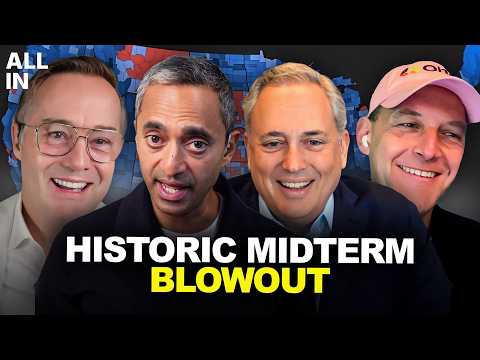
Midterm Blood Bath, $4T AI Sell Off, Data Center Freeze, What’s Next for Trump

Video thumbnail: Midterm Blood Bath, $4T AI Sell Off, Data Center Freeze, What’s Next for Trump
Nov 7, 20261h 33m 4s video lengthAll-In Podcast

The Signal

The recent U.S. midterm elections resulted in a sweeping Democratic victory, which the panel interprets as a sharp repudiation of the current administration. While there is consensus that voter frustration over affordability and cost-of-living drove the backlash, speakers are split on whether the Iran war—which began February 28, 2026—was the primary catalyst or merely the most visible symptom of a broken economic structure that favors asset owners over wage earners.

The Case

The Midterm Breakdown

  • Democrats won both chambers of Congress and at least 29 governorships in a result described as a Watergate-level repudiation of the Republican administration.
  • Sachs and JCal argue the war’s inflationary impact on gas, diesel, and food prices was the decisive factor, asserting that ending the war could rapidly lower Brent crude prices and reset the political approval landscape.5:07
  • Chamath disputes that the war is the primary cause, framing the election instead as a structural rejection of an economy where wage earners feel shut out of growth while asset owners compound wealth.19:52

AI and Infrastructure Politics

  • The speakers identify data-center permitting as a new political choke point, noting that some states are already halting new approvals until legislation is passed, which could effectively push frontier AI development to countries like Mexico or the Middle East.3:29
  • AI governance is framed as a power struggle over compute rather than just safety, with concerns that regulators may use infrastructure bottlenecks to exert state control over information.65:08
  • Freeberg highlights a recent 175-page OpenAI research paper that claims to have disproved the exponential time hypothesis, a major theoretical breakthrough that—if validated—could fundamentally reshape what problems computers can solve.84:44

Political Trajectory

  • The panel suggests Trump’s legacy hinges on whether he pursues a "deal-mode" recovery, including concrete populist reforms like tax thresholds for lower earners, housing incentives, and banning stock trading for officials.46:39
  • There is shared concern that if the administration fails to course-correct, the party risks a prolonged period of political decline similar to the Bush administration’s final years.52:14

The 1 Minute Signal Take

The election signals that voters are prioritizing economic fairness over party ideology, making affordability the central metric for political survival. Unless the current administration secures a course-correcting "populist bargain" that addresses cost-of-living while navigating the emerging political hostility toward AI infrastructure, the current electoral trajectory suggests a durable shift in domestic power.

Pro Analysis

Why It Matters

The transition from an industrial economy to an AI-dominated one is colliding with a volatile populist backlash. This shift is not merely technological but fiscal and structural, threatening to fragment the domestic supply chain for the most critical resource of the century: compute.

Strategic Implications

  1. Infrastructure Risk: The 'data-center freeze' is a strategic bottleneck. If states prioritize local utility costs over national AI capacity, the U.S. risks a strategic disadvantage that cannot be quickly reversed.
  2. Populist Realignment: The electoral success of populist messaging suggests that any policy path lacking a clear, material impact on wage-earner affordability will be rejected by voters in 2028.
  3. Regulatory Capture: As federal AI legislation looms, the primary risk is not just safety, but the creation of 'regulatory moats' where only incumbent giants can survive the compliance overhead.

Evidence & Hype Audit

  • Reliability: The political analysis is highly credible regarding the voter sentiment toward affordability, but the causal weight assigned to specific events (like the war) is subjective and varies by speaker.
  • Scientific Credibility: The discussion of the OpenAI paper is highly speculative. While the excitement is palpable, it is explicitly framed as an unverified breakthrough, not a settled scientific fact.

Counterarguments

  • Economic Determinism: The speakers might be over-attributing election results to inflation and war, ignoring that midterms historically punish incumbents regardless of specific geopolitical events.
  • Permit Hysteria: Local resistance to data centers may be a standard negotiating tactic to extract community benefits (lower taxes, cheaper power) rather than an existential threat to AI buildout.

Who Should Care

  • Investors: Monitor data-center permitting trends as a leading indicator for AI hardware adoption.
  • Policymakers: Recognize that infrastructure buildout is no longer a technocratic issue; it is a primary political liability.
  • Technologists: Treat the OpenAI scientific claim as an 'option' on future breakthroughs rather than an immediate change in production capabilities.

What to Do Next

  • Track Permitting: Monitor specific state-level legislative action in Texas and Arizona as bellwethers for the industry.
  • Follow Peer Review: Watch for independent mathematical verification of the OpenAI paper before adjusting research strategies.
  • Analyze Populist Deals: Evaluate which legislative packages (tax reform, wage hikes) could actually pass the current, fractured Congress.
  • Diversify Compute: For businesses, hedge against potential domestic supply bottlenecks by identifying off-shore compute options.
Time saved:1h 29m 5s

Share this

Tags

Written by: 1 Minute Signal Editorial Team