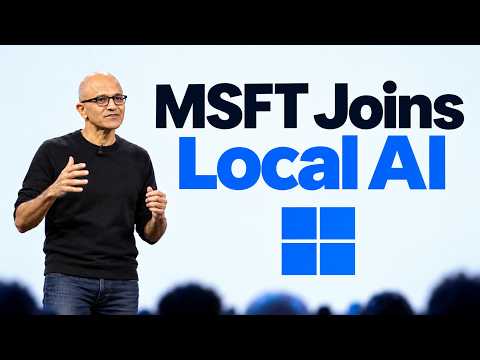
Microsoft Joins the Local AI Push

Video thumbnail: Microsoft Joins the Local AI Push
Oct 8, 202613m 29s video lengthSam Witteveen

The Signal

Microsoft recently unveiled a hybrid AI strategy for Windows that prioritizes local model execution over cloud-only workflows. By using a dynamic router that selects between on-device and cloud compute, the company aims to make local AI a standard platform feature. The move is underpinned by aggressive quantization and new hardware-runtime integrations, though its practical reliability remains contested.

The Case

Routing and Execution

  • Microsoft demonstrated an "intelligent routing" system in GitHub Copilot that offloads bulk coding tasks to local models while using cloud models for high-level planning.1:17
  • The demo showed a significant shift in token economics, with roughly 150:1 of the 1.6 million tokens processed locally rather than in the cloud.2:38
  • While the demo confirmed local execution—even in airplane mode—the system's ability to reliably escalate failed local tasks back to the cloud remains unproven.3:50

Model Quantization

  • Microsoft is pushing extremely aggressive quantization, featuring a 3-bit "AI Code 1.1 Flash" model with a 256K context window and a 1.6-bit version of DeepSeek-4 running in 60GB of memory.4:23
  • These low-bit implementations are presented as high-performance, but their stability regarding long-context memory pressure and tool-calling accuracy is currently subject to industry skepticism.6:36

Hardware and Infrastructure

  • To support these local workloads, Microsoft is integrating llama.cpp into Windows ML, aiming to provide day-one compatibility for diverse open-source models without requiring specialized packaging.8:27
  • New hardware like the NVIDIA RTX Spark offers up to 128GB of unified memory with CUDA support, with pricing starting at $2,600 and a future Windows-based DGX Station teased for later this year.11:01
  • Microsoft Execution Containers (MXC) were introduced as a sandbox layer, allowing organizations to enforce access policies and attribute agent actions directly to specific identities.10:21

The 1 Minute Signal Take

Microsoft’s shift toward local AI is a significant bet on hardware-accelerated, private-by-design compute, but the firm's reliance on ultra-low-bit quantization introduces unresolved risks for coding reliability. The success of this platform will depend not just on the hardware’s capability, but on whether the routing logic can gracefully handle complex failures that were omitted from the initial demo.

Pro Analysis

Why It Matters

Microsoft is attempting to turn the Windows desktop into a first-class AI development environment, effectively challenging the cloud-native hegemony of AI services. By combining hardware (RTX Spark), runtime (Windows ML/llama.cpp), and orchestration (hybrid routing), they are creating a vertical stack that could force enterprise customers to keep more of their data and processing on-premises.

Strategic Implications

This move forces a choice for AI-first companies: either lean into Microsoft’s local-routing ecosystem or build proprietary, opaque routing logic that risks becoming obsolete. The shift toward ultra-low-bit quantization (1.6-bit) suggests that Microsoft believes 'good enough' local intelligence is more valuable than 'perfect' cloud intelligence for the majority of developer workflows.

Evidence & Hype Audit

The content relies on demonstrations and stage claims rather than peer-reviewed benchmarks or third-party validation. While the technical logic of routing and quantization is sound, the claims regarding 'outperforming benchmarks' at 1.6 bits remain unverified. It is a mixture of genuine infrastructure progress and highly optimistic product marketing.

Counterarguments

Critics might argue that local quantization is a race to the bottom, where the 'intelligence' of a model is fundamentally hollowed out, leading to subtle, hard-to-debug errors in complex reasoning or tool-calling tasks that are more costly than cloud token fees.

Role-Specific Takeaways

  • Devs: Focus on how the router handles your specific codebase; verify that code generation remains accurate at 3-bit quantization.
  • IT Admins: Evaluate MXC as a tool for restricting what agents can touch within your local production environments.
  • Buyers: If purchasing RTX Spark, assess whether the 128 GB memory limit is sufficient for the specific long-context window models your team intends to run.

What to Do Next

  • Conduct a comparative audit of your current cloud-based coding agent versus a local 3-bit implementation.
  • Map out your current agentic workflows to see which segments could be offloaded to local models.
  • Review your organization's data privacy policies to see how local execution simplifies compliance requirements.
  • Set up a test environment using the Llama.cpp/Windows ML stack to experiment with non-Microsoft model variants.
Time saved:9m 59s

Share this

Tags

Written by: 1 Minute Signal Editorial Team