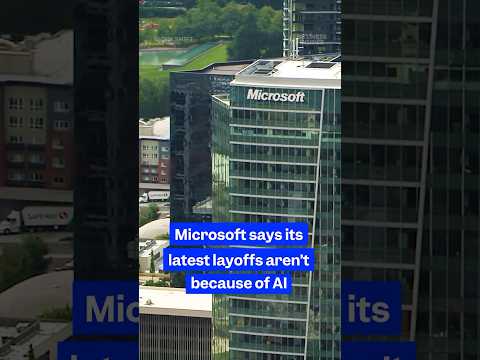
Microsoft laid off nearly 5,000 employees. It says AI isn't the reason. #Microsoft #tech #AI

Video thumbnail: Microsoft laid off nearly 5,000 employees. It says AI isn't the reason. #Microsoft #tech #AI
Jul 8, 20261m 12s video lengthBusiness Insider

The Signal

Microsoft has announced layoffs affecting approximately 4,800 employees, or 2.1% of its global workforce, with cuts concentrated in sales and Xbox gaming teams. While the company maintains an explicit denial that roles are being replaced by AI, management acknowledges that AI is automating daily tasks, creating significant tension as Microsoft simultaneously slashes costs to fund massive AI infrastructure investments.

The Case

The Layoff Scope

  • Microsoft is cutting 4,800 roles, with the Xbox division carrying a heavy burden: 1,600 positions are eliminated immediately as part of a broader plan to reduce the Xbox workforce by 20% throughout this fiscal year.0:10
  • These involuntary cuts follow a voluntary retirement program offered earlier in 2026, where roughly 3,000 workers—one-third of 9,000 eligible employees—accepted buyouts, which helped mitigate the total number of layoffs.0:37

The AI Tension

  • Amy Coleman, the chief of HR at Microsoft, stated that the layoffs are not a direct replacement of staff with AI, yet she concurrently emphasized that AI has already begun automating daily tasks and altering fundamental work processes.
  • The company is operating under heavy fiscal pressure, simultaneously tightening costs in specific divisions while funneling capital into AI infrastructure, a dual strategy that has fueled market anxiety.

Market Reaction

  • Investors are increasingly concerned that AI technology could cannibalize Microsoft's traditional software revenue, contributing to a 19% decline in stock price during June—the company's worst monthly performance since the height of the dot-com era.0:54

The 1 Minute Signal Take

Microsoft is essentially attempting to pivot its cost structure toward long-term AI bets while insulating its core business from market-driven volatility. The discrepancy between denying direct AI replacement and admitting to widespread task automation underscores a shift in the nature of work that goes deeper than simple head-count adjustments.

Pro Analysis

Why It Matters

This situation represents a classic corporate tension: the transition from a mature, cash-cow software business to an unproven, high-capex AI future. Microsoft is betting its long-term survival on AI at the direct expense of its current human capital and operational stability.

Strategic Implications

The strategy signals a shift in corporate priorities from stability to 'AI-readiness.' By gutting specific divisions like Xbox and Sales, Microsoft is signaling that mature product lines are now secondary to the infrastructure required to scale artificial intelligence capabilities.

Evidence & Hype Audit

The content relies on a mix of factual headcounts (4,800 layoffs) and unverified corporate narratives. The link between AI fear and the 19% stock drop is asserted by the source but lacks a granular market breakdown, making it a correlation rather than a proven causal link.

Counterarguments

One could argue that the layoffs are a necessary correction to over-hiring cycles during previous boom years, and that linking them to AI is a narrative construct designed by critics to frame the shift as dystopian rather than administrative.

Who Should Care

  • Employees: Specifically those in mature product divisions, as their roles are most likely to be 'reshaped' by automation.
  • Investors: To watch if the massive R&D spend leads to actual software revenue or continues to erode the stock price.
  • Managers: Evaluating how to balance productivity gains from AI with the unavoidable cultural cost of mass layoffs.

What To Do Next

  • Audit personal workflows for tasks now automatable by core AI tools.
  • Diversify skill sets toward AI infrastructure management or high-level strategic product design.
  • Monitor Xbox division quarterly performance to gauge if restructuring impacts product quality.
  • Track total non-AI software revenue as a percentage of total earnings for indicators of potential cannibalization.

Share this

Tags

Written by: 1 Minute Signal Editorial Team