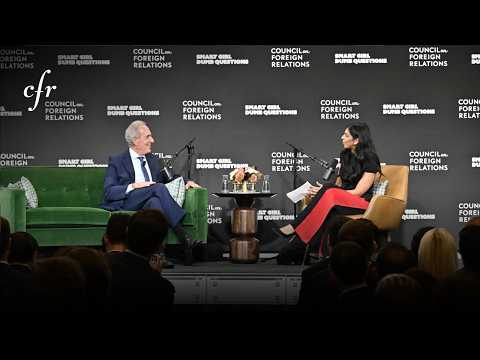
Live Smart Girl, Dumb Questions Podcast With Michael Froman and Nayeema Raza

Video thumbnail: Live Smart Girl, Dumb Questions Podcast With Michael Froman and Nayeema Raza
Nov 3, 20261h 12m 26s video lengthCouncil on Foreign Relations

The Signal

Michael Froman, president of the Council on Foreign Relations, argues that the current global wave of distrust and protest is a long-running legitimacy crisis caused by an economic deal that prioritized globalization without sufficiently planning for concentrated local costs. He asserts that while the U.S. remains globally essential, maintaining its leverage and soft power now requires deepening alliances and investing in domestic ecosystems rather than opting for isolationism.

The Case

Origins of Instability

  • Froman characterizes the current unrest as a breakdown of the social contract where youth are losing faith in future life prospects, arguing this discontent predates the 2008 financial crisis and can be traced to the globalization backlash of the 1999 Seattle WTO protests.1:58
  • He explains that globalization’s benefits—such as affordable consumer goods—were broad but invisible, while its costs, including shuttered factories and hollowed-out towns, were highly localized and visible, fueling a predictable political resentment.7:08

U.S. Power and Alliances

  • Froman contends the U.S. maintains significant leverage through its universities, rule of law, and entrepreneurship, but warns this soft power is vulnerable if policy neglect drives international talent and R&D investment to rivals like Canada or Europe.13:58
  • He describes interdependence as double-edged; while it enables prosperity, it is now being weaponized through supply-chain chokepoints and critical-mineral dependencies, necessitating a trade-off between economic efficiency and national security resilience.18:07
  • He characterizes the recent U.S. pressure on alliances as a legitimate effort to demand burden-sharing that began before Trump, noting that regional cooperation in Asia and Europe has increased as a direct result of these security stresses.12:44

The AI and China Outlook

  • Froman frames AI as the next globalization event with the potential to disrupt labor markets at a scale far beyond the 2 to 3 million U.S. jobs lost to trade, yet warns that policymakers are repeating past mistakes by identifying the disruption without building adequate worker-transition tools.4:58
  • On China, he identifies demographics as the primary long-term constraint, predicting the population could drop from 1.3 billion to 700 million over the century, and suggests the near-term relationship will likely focus on stability rather than fundamental transformation.33:32

The 1 Minute Signal Take

The core takeaway is that the U.S. cannot restore stability by retreating, but must instead modernize its social contract to address the concentrated domestic costs of its foreign policy. Froman signals that for the next few years, the primary strategic task for the U.S. is not to pursue total victory over rivals, but to manage a world of weaponized interdependence through disciplined alliance coordination and renewed investment in domestic human capital.

Pro Analysis

Why It Matters

This discussion highlights a pivotal shift in the American foreign policy establishment. The transition from 'market efficiency' as a primary objective to 'resilience and security' marks a fundamental pivot in the post-WWII consensus. Froman’s framing acknowledges that if Western institutions cannot address the domestic political fallout of economic change, their ability to project power abroad will wither.

Strategic Implications

  1. The Burden of Security: Nations must now factor the 'resilience premium' into their industrial policies. We are moving from a just-in-time world to a 'just-in-case' world.
  2. The AI Labor Gap: The failure to plan for globalization’s losers created the current populist moment. If the AI transition repeats this, the resulting political volatility could threaten democratic stability itself.

Evidence & Hype Audit

Froman provides strong qualitative observations backed by his extensive background, but his claims regarding China's future population and European market dynamics are asserted rather than demonstrated. His reliance on CFR survey data to characterize the American public's mood is a useful heuristic, though it lacks the granularity of a rigorous public-opinion study.

Counterarguments

Critics might argue that Froman’s 'alliance-based leverage' is a mask for continued status-quo management. A more radical critique suggests that the institutional architecture he defends (CFR, WTO-era trade norms) is fundamentally incapable of solving problems that were, in part, created by those same institutions.

Who Should Care

  • Policy Strategists: For understanding the shift toward allied-centric, resilient supply chains.
  • Tech Leaders: For understanding the rising political pressure to provide worker-transition funding.
  • Investors: For the pivot in sovereign debt and the geopolitical risk to cross-border manufacturing.

What to do next

  • Audit supply chain dependencies beyond just semiconductors, specifically in pharmaceuticals and magnets.
  • Invest in regional, place-based pilot programs for AI retraining to gather real-world data.
  • Prioritize electrification projects in developing markets, as this remains the most significant development hurdle for the next decade.
  • Engage with nonpartisan institutions to bridge the divide between local economic reality and national policy strategy.
Time saved:1h 8m 33s

Share this

Tags

Written by: 1 Minute Signal Editorial Team