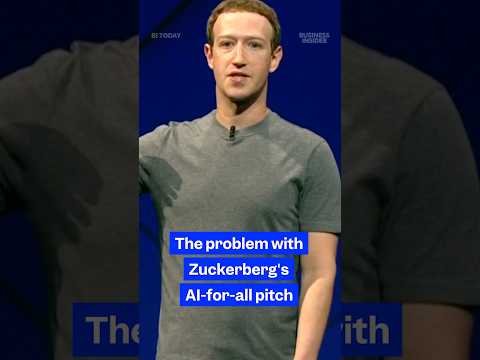
Mark Zuckerberg wants an #AI future for everyone. Getting people on board is the hard part. #Meta

Video thumbnail: Mark Zuckerberg wants an #AI future for everyone. Getting people on board is the hard part. #Meta
Aug 12, 20261m 45s video lengthBusiness Insider

The Signal

Mark Zuckerberg is launching a public campaign to reframe superintelligence as an aspiration rather than a threat, publishing a 6,500-word manifesto alongside the release of Meta’s new agentic AI, Muse Glimmer. Meta is attempting to balance this ideological shift with a tangible mitigation strategy for the infrastructure backlash caused by AI data centers. The central tension remains whether the company can translate its existing consumer-attention business into mass adoption of personalized AI tools while facing unresolved public skepticism.

The Case

Strategic Pivot and Product Rollout

  • Zuckerberg is advocating for "AI for all" to shape public perception, a 6,500-word initiative that mirrors similar essays from leadership at Anthropic and Microsoft.0:04
  • The campaign's timing is linked to the launch of Muse Glimmer—a new openweight agentic model designed to run locally on a laptop and execute complex coding or administrative tasks in sequential steps.0:25
  • Meta’s core business model, which relies on selling access to user attention via platforms like Facebook and Instagram, restricts the company to a consumer-facing AI strategy rather than a traditional business-to-business pivot.

Overcoming Social Friction

  • The company identifies "getting everyone on board" as the primary obstacle to progress, acknowledging that users are particularly sensitive to AI and the physical data centers required to power it.
  • To dampen local opposition, Meta is committing a $1 billion community fund for regions where it constructs new AI data center infrastructure.0:50
  • While the company argues its extensive store of individual-level data uniquely enables the creation of highly personalized AI assistants, it remains unproven whether this technical advantage—or financial placation—can successfully overcome deep-seated public hesitation.1:31

The 1 Minute Signal Take

Meta’s aggressive push into agentic AI hinges less on technical model capability and more on social engineering; the company is betting that a combination of local financial incentives and highly personalized consumer products can bypass broad-based cultural resistance. Whether this strategy succeeds remains a point of significant contention, as no amount of funding or product design has yet reconciled the public's conflicting attitudes toward AI infrastructure.

Pro Analysis

Why it Matters

Meta’s approach represents a shift from selling products to selling legitimacy. By anchoring its AI strategy in both phil...
Full analysis always available on Pro.

Share this

Tags

Written by: 1 Minute Signal Editorial Team