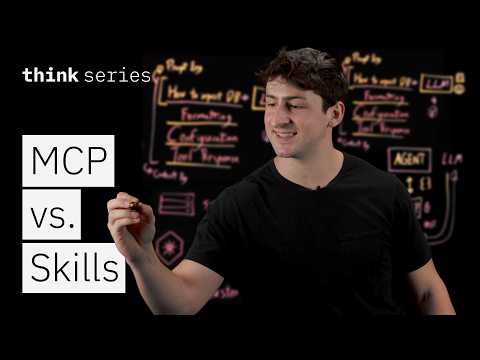
MCP vs Skills: Which Is Right for Your AI Agent and LLMs?

Video thumbnail: MCP vs Skills: Which Is Right for Your AI Agent and LLMs?
Jul 7, 20268m 3s video lengthIBM Technology

The Signal

Effective LLM interaction requires moving from simple prompt engineering to context engineering—supplying the model with external data and reusable procedural constraints. The industry now distinguishes between two mechanisms for this: the Model Context Protocol (MCP) for accessing live external systems, and skills for encapsulating reusable, repeatable task behaviors.

The Case

Integrating External Data

  • The Model Context Protocol (MCP) acts as a standardized interface between LLMs and external data sources, abstracting service APIs into an understandable format so models can query systems like CRMs, Virtual Machines, or cluster states.2:55
  • MCP handles security by managing authentication and issuing uniquely scoped tokens, allowing for controlled read-write access that avoids the risks associated with manually copying full API documentation into a context window.
  • A typical flow involves the LLM sending a specific JSON request to an MCP server, which then translates the command into standard service calls like POST or GET.3:23

Packaging Reusable Capabilities

  • Skills are lightweight, auto-loadable packages consisting of a markdown file, metadata, and associated scripts or resources designed for repeatable tasks like debugging code, cleaning Excel files, or running compliance checks.4:56
  • These packages reside in a local folder and are programmed to trigger automatically only when a user’s query matches the skill's specific purpose, helping mitigate the inconsistency often present in models.5:39
  • The choice between the two is pragmatic: use MCP when you need real-time, permissioned access to live infrastructure; use skills when you need to enforce a consistent workflow or custom capability without the overhead of full system integration.6:12

The 1 Minute Signal Take

While the source claims widespread ecosystem adoption for both MCP and skills, those assertions remain unevidenced. The takeaway is the shift toward modularizing how AI agents access data and procedures, using MCP as your secure integration pipe and skills as your reusable toolkit.

Pro Analysis

Strategic Implications

The divergence between MCP (Infrastructure/Connectivity) and Skills (Logic/Procedural) mirrors the broader shift from simple chatbot wrappers to actual autonomous agents. By decoupling connectivity from logic, developers gain granular control over how agents interact with the world. Organizations that master these standards will likely see a reduction in 'hallucinated' procedure and improved security, as agents no longer need blanket access tokens.

Evidence & Hype Audit

The video makes bold claims about ecosystem-wide adoption and 'open source' universality for both MCP and skills. These assertions lack citations or verifiable ecosystem statistics and should be categorized as industry-standard marketing enthusiasm rather than proven technical facts. While the structural definitions are clear, the universality of these patterns in the current AI landscape is likely overstated.

Counterarguments

Critics might argue that MCP introduces a unnecessary layer of abstraction that increases maintenance overhead. Similarly, 'skills' as a concept can be perceived as just another variation of system prompting or RAG retrieval mechanisms rather than a fundamentally distinct paradigm. There is also the risk that reliance on these specific patterns could lead to vendor lock-in if the underlying standardizations are not as widely adopted as the content implies.

Recommended Actions

  • Review current agent error logs to see if failures are due to insufficient data access (MCP candidate) or inconsistent output formatting (skill candidate).
  • Map existing manual API configurations against the MCP framework to identify potential consolidation points.
  • Create a pilot 'skill' package for your most frequent, high-effort task to measure performance improvement compared to base prompt engineering.
  • Design a security matrix for agent-accessed systems before moving to the permissioned model provided by MCP.
  • Stay tuned for upcoming developments in build-time CLI tools for agents to minimize repetitive configuration effort.
Time saved:5m 1s

Share this

Tags

Written by: 1 Minute Signal Editorial Team