
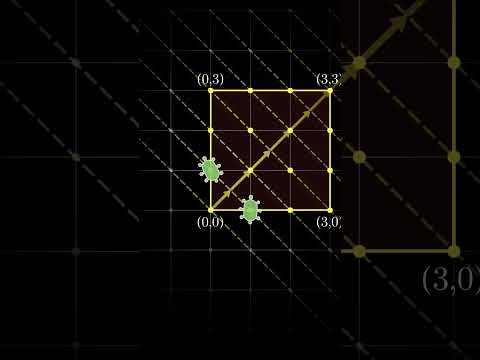
- The complexity of the grid expansion appears to grow at a rate that precludes simple simulation or brute force computation.
- Conservation laws (invariants) allow one to map infinite potential outcomes to a single constant value.
- The geometric series sum of the grid provides a total capacity limit (weight of 4) against which any sub-region can be measured for accessibility.
Channel: 3Blue1Brown
Bacteria Grid Puzzle Solution
This video examines a mathematical puzzle involving cellular replication on a grid to demonstrate how invariant quantities can prove the impossibility of certain growth patterns.
Key Takeaways
- Mathematical invariants provide a powerful tool to constrain the possible states of a system that would otherwise seem computationally intractable.
- The total weighted sum of bacteria on the grid remains fixed at one, effectively creating a potential barrier that restricts movement beyond specific spatial boundaries.
- Showing that the sum of weights required to populate a region exceeds the total available weight proves the system cannot reach those states, regardless of the number of moves.
Talking Points
Analysis
Importance
This explanation is a masterclass in applying formal logic to discrete math puzzles. In technical problem-solving, it demonstrates shifting from simulation to constraint-modeling.
Who should care
Engineers and developers dealing with state-space trees or distributed systems should care. Often, we try to solve problems by optimizing the 'how'—the set of moves—when the real insight is defining the 'boundary condition' of what is even achievable.
Contrarian Takeaway
The most valuable information often hides in the limits of the system rather than the mechanics. Even with 'infinite time,' some systems exhibit fundamental boundaries that no amount of computation or optimization can overcome, an essential concept for software architecture design where throughput constraints are often physical or logical constants.
Time saved:
Channel: 3Blue1Brown