
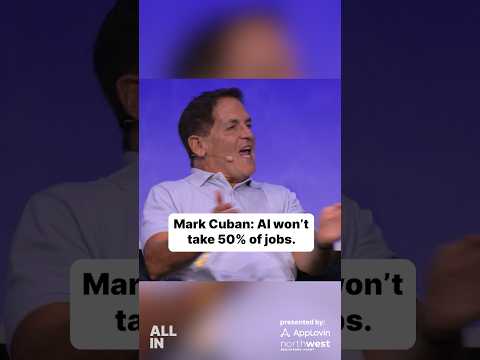
Why It Matters
Cuban's perspective provides a necessary counterweight to the prevailing 'total displacement' narrative. By centering the argument on the 'programming mindset' needed to effectively deploy AI, he shifts the conversation from inevitable obsolescence to a question of technical literacy and professional adaptability.
Strategic Implications
If Cuban is correct about the required 'programming mindset,' the advantage accrues to those who learn to bridge the gap between human intent and machine execution. This suggests that the future labor market won't necessarily be 'humans vs. AI,' but rather 'those who can effectively command AI vs. those who cannot.'
Evidence & Hype Audit
This content is highly subjective and leans heavily on assertion rather than data. There are no cited studies or models to back the '50% job loss' rebuttal, and the 'big utilization' claim in specific countries is anecdotal. Treat this as a high-level strategic viewpoint rather than a predictive labor-market analysis.
Counterarguments
The biggest risk to the speaker's argument is the assumption that the 'programming mindset' requirement is permanent. As interface layers (like natural language agents) improve, the technical barrier to entry is dropping rapidly. If the barrier disappears, the current technical limitations may not be enough to prevent significant job displacement.
Role-Specific Takeaways
- For Employees: Focus on upskilling in AI-driven workflows to become the person who controls the tool.
- For Entrepreneurs: Look for the current 'friction points'—tasks that regular people need but find too hard to use AI for—and build solutions there.
What To Do Next
- Audit your daily workflows to identify which tasks feel like 'programming' or require constant 'iteration'.
- Dedicate time to mastering prompt engineering to iterate and debug more efficiently.
- Research which specific industries are seeing the highest adoption in the regions mentioned (e.g., Brazil/India) to spot potential global trends.
- Shift your professional focus toward output-oriented tasks that AI cannot yet reliably perform for your specific sector.