
Why it Matters
This approach solves the perennial problem of 'prompt bloat' in complex agent systems. By treating skills as loadable resources rather than baked-in context, developers can scale agent capabilities without hitting token limits or diluting the agent's focus.
Strategic Implications
This architecture favors a modular ecosystem where skills can be versioned, shared, and swapped. The ability to push local files to a managed remote hub creates a hybrid development workflow: developers iterate locally, while product managers or operators can tweak agent logic via the Context Hub UI without touching source code.
Evidence & Hype Audit
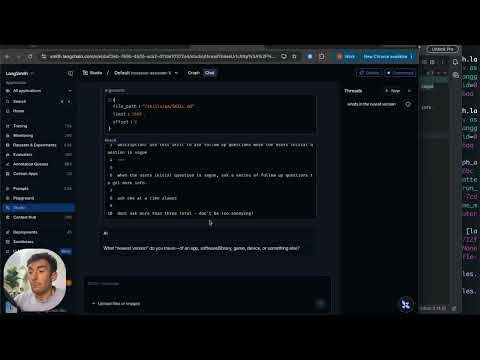
This is a highly practical, evidence-based demonstration. The speaker provides a clear trace of the tool-calling loop, verifying exactly how the agent detects, reads, and executes a skill. There is little hyperbole; the claims are mapped directly to observable file operations.
Counterarguments
Critics might argue that deferring skill knowledge to a secondary file-read step adds latency to the agent's response. Additionally, relying on file system access for logic execution increases the complexity of security audits—one must now secure the file system and the execution environment, not just the LLM prompt.
Who Should Care
- AI Systems Engineers: Building scalable agent-based workflows.
- Product Managers: Managing agent behaviors via remote UIs.
- Developer Experience (DX) Leads: Looking for better ways to manage agent instructions and tool-sets.
What to do next
- Audit existing agent prompts to see what can be moved into a modular skill file.
- Implement a 'progressive disclosure' pattern if you have large, rarely used instructions.
- Test the performance cost of file-reading tool calls in your specific agent loop.
- Set up a staging environment that mirrors your Context Hub deployment to avoid production drift.
- Define clear schemas for your
skill.mdfiles to ensure consistent agent interpretation.