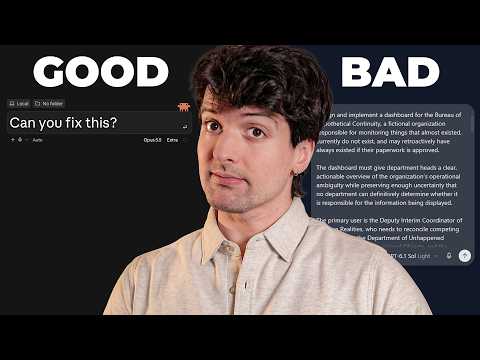
Make Your Prompts Dumber

Video thumbnail: Make Your Prompts Dumber
Oct 18, 202631m 48s video lengthTheo - t3․gg

The Signal

Engineers are currently stuck in a 'trough of despair' where they feel AI renders their craft obsolete, leading to a focus on complex, brittle feature-building. The speaker argues this is a misapprehension: the most effective AI-era workflows prioritize prompting for outcomes over building hard-coded UI, shifting the true value of engineering toward deeper system primitives, pipelines, and observability.

The Case

Shift to Outcome-Based Workflows

  • The speaker frequently replaces proposed product features with simple prompts, arguing that many user requests are for information—like tool-call timing or context usage—that models can surface directly without new UI.7:14
  • A debugging and support flow for 'T3 Code'—a developer tool the speaker maintains—was reduced from a complex branching application to a single terminal command, npx t3 triage, that pipes a 30-line markdown prompt into a coding agent to handle repro steps, file issues, and scrub secrets.14:32
  • Automating email monitoring and support triage through prompt-based agents, rather than building bespoke portals, allowed the speaker to reduce their inbox checking from ten times a day to once.23:08

Debugging and System Primitives

  • Audits revealed that Claude—a leading large language model—was failing tool calls because it formatted 'ripgrep' search commands for bash, which frequently broke in zsh environments; identifying this required observing model behavior at the shell layer.5:21
  • Prompting can surface hidden operational overhead, such as when the speaker discovered Railway was silently dumping 70,000 tokens of context into every request, a discovery that changed how they manage system inputs.9:55
  • The speaker contends that AI does not eliminate engineering but rather forces a shift toward building 'deeper' infrastructure—such as custom JavaScript runtimes, memory management primitives, and better connection layers—to support agent workloads.26:05

Agent Capabilities

  • Engineers can discover the limits of current models by explicitly asking them to list their own capabilities, such as mouse actions, accessibility tree reading, and browser-tab control, then using that map to design better tool integrations.20:01
  • The speaker suggests that when a specific prompt pattern proves valuable, it should be codified into reusable skills or configuration files rather than left as a one-off interaction.13:13

The 1 Minute Signal Take

The most significant barrier to AI-driven productivity is not model capability, but the tendency to treat AI as a tool to be 'built around' rather than a collaborator that can replace the need for complex internal tooling. Success in this environment requires engineers to stop obsessing over prompt syntax and start architecting the primitives and data pipes that allow agents to act independently.

Pro Analysis

Why it matters

This video challenges the prevailing 'product-first' design philosophy. It suggests that if a machine can infer intent and gather data, the human-built UI for that intent is often just noise. This flattens the distinction between the 'user' and the 'developer' in the context of tooling.

Strategic implications

  • For Product Teams: Don't build what you can delegate. If a dashboard's only function is to display logs that an LLM can summarize, kill the dashboard and optimize the API for LLM consumption.
  • For Architects: The future of software is not just the application, but the 'connective tissue' (MCP, etc.) that allows models to reach into systems and perform actions.

Evidence & Hype Audit

  • Hype Factor: High. The speaker is an active promoter of the tools discussed (T3, Macroscope).
  • Trustworthiness: Low to Moderate. The core arguments are based entirely on personal anecdotes and internal team workflows. There is no comparative analysis of where this philosophy fails.

Counterarguments

  • Reliability: Prompt-first workflows are inherently non-deterministic. A hard-coded feature provides a consistent contract, which is vital for enterprise-grade tooling.
  • Discoverability: If every function is hidden behind a conversational prompt, new users have no idea what the software is capable of without trial and error.

Who should care

  • Software Engineers: If you feel your work is becoming trivialized, this framework gives you a path to reclaim high-value system design.
  • Product Managers: Stop adding 'nice-to-have' features. Focus on building better primitives.

What to do next

  • Audit your existing product features and ask: 'Could this be a prompt?'
  • Create a 'triage' prompt for your project to handle bugs without custom UI.
  • Start logging tool-call durations to identify bottlenecks.
  • Redesign your API to better support agent-driven inspection.
  • Stop over-engineering your prompts; focus on the desired outcome.
Time saved:28m 8s

Share this

Tags

Written by: 1 Minute Signal Editorial Team