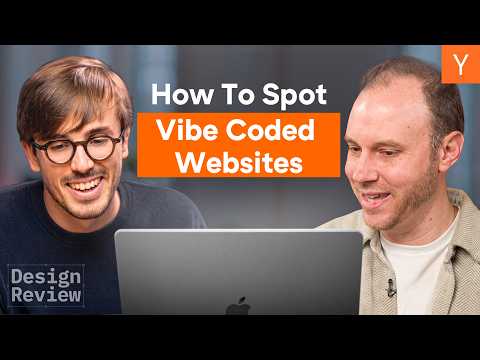
Magic Patterns CEO Reviews Startup Websites

Video thumbnail: Magic Patterns CEO Reviews Startup Websites
Oct 22, 202647m 43s video lengthY Combinator

The Signal

Magic Patterns, an AI design tool built to translate concepts into interactive code, is shifting from simple prompt-to-prototype generation toward an "OS" for multi-threaded design. The company’s trajectory reveals a fundamental tension in AI product development: balancing the speed of generative iteration against the clarity required to drive actual user conversion.

The Case

Product Strategy

  • Magic Patterns — a tool for non-designers that evolved after several pivots — now frames its canvas as an "OS" for managing code, PRDs, and visuals because users require a workspace for context, not just a single generation thread.10:40
  • Usage data dictates product direction, most notably with the Model Context Protocol (MCP), which launched as a hackathon experiment and exploded into a core interaction mode for users pulling context from environments like Cursor.4:09
  • The company argues that AI allows for both high-speed delivery and design excellence, provided teams resist the temptation to treat AI as a shortcut that bypasses user-centric polish.44:43

UX and Landing Page Critique

  • Website design often fails when "vibe-coding"—the use of excessive animation, scrolljacking, and abstract terminology—obscures the core CTA and product purpose, ultimately causing users to drop off.18:24
  • A landing page's effectiveness hinges on clarity: the most successful critiques emphasized that trust-building features, such as clear security messaging, must be prominent for AI apps that handle sensitive user data like email or system logs.28:21
  • Animation is categorized as a failure when it exists for decoration but a success when it reinforces the product metaphor, such as a laptop waking from sleep to indicate proactive AI work.25:53

The 1 Minute Signal Take

Designing AI products now requires a transition from simple prompt-based interactions to context-rich environments where the interface itself acts as an organizational layer. For founders, the lesson is that while AI can generate aesthetics instantly, conversion remains a function of usability and explicit value communication, not decorative novelty.

Pro Analysis

Why it matters

The current wave of AI landing pages reflects a transition from 'proof-of-concept' marketing to 'product-market fit' marketing. When the tools to generate polished visuals are cheap and ubiquitous, the primary differentiator shifts back to fundamental UX: clarity of value, user-centric information architecture, and trust.

Strategic Implications

For founders, the lesson is clear: your product's visual identity should serve its function. The 'vibe-coded' trend is a transient phase of AI-native design where the novelty of the generation process obscured the need for effective conversion paths. Future-proof designs will be those that integrate AI-enabled interactivity without sacrificing standard web conventions that users rely on for navigation and control.

Evidence & Hype Audit

The content is high-signal regarding UX principles, though the specific claims about product adoption (e.g., 'MCP usage exploded') are self-reported anecdotes. The critique of landing pages is grounded in standard conversion-rate optimization (CRO) heuristics rather than proprietary data, but these principles are broadly accepted in the professional design and product communities.

Counterarguments

One could argue that 'vibe-coded' sites are successful because they signal membership in a specific, high-end tech subculture. If the goal is to attract early-adopter engineers or investors who value aesthetic novelty, these designs might serve their purpose, even if they under-perform on traditional 'mass-market' conversion metrics.

Who should care

  • Founders: To audit your current landing page against conversion friction.
  • Product Managers: To understand the evolving requirements of 'canvas-based' AI workflows.
  • Designers: To see how AI tools are changing the definition of a 'designer' in the development lifecycle.

What to do next

  • Audit your landing page hero: Can a stranger identify your product, audience, and action within 5 seconds?
  • Remove all non-essential animation that triggers automatically on scroll.
  • Move your security/trust statements to the primary navigation menu.
  • Conduct an 'anonymous' feedback session where users describe your product after seeing only your home page.
  • If your product handles private data, explicitly state your data-handling policy on the landing page.
  • Standardize your typography and brand assets to avoid the 'generic AI' look.
Time saved:44m 21s

Share this

Tags

Written by: 1 Minute Signal Editorial Team