
Back to Feed
I miss when programmers were lazy.
The Signal
Programming authority Brian Cantrell’s classic trio of virtues—laziness, impatience, and hubris—must now be re-evaluated as software engineering faces an "anabolic steroid" in LLMs. While these tools can accelerate development, the central tension lies in whether AI-assisted coding encourages disciplined abstraction or merely masks sloth under a deluge of vanity metrics and bloated, redundant systems.
The Case
- Laziness is framed not as inactivity, but as the rigorous, upfront work of building simple abstractions to eliminate future maintenance and cognitive load.
- Impatience is defined as the restless desire to fix technical debt immediately, while hubris provides the conviction necessary to rewrite systems from scratch.
- The speaker claims LLMs decouple code volume from discipline, allowing "slop" to accumulate within projects that would historically have collapsed under their own weight.
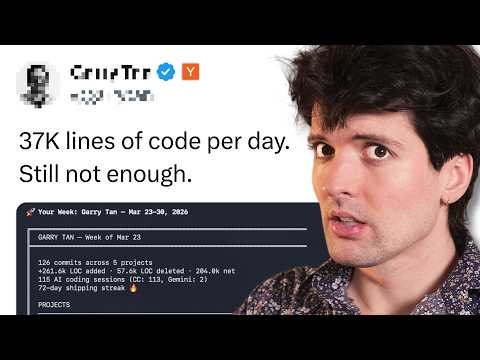
- Gary Tan, an industry figure, serves as the primary foil for this critique, having boasted of producing 37,000 lines of code daily across five projects.
- A third-party audit of Tan’s work allegedly uncovered significant "vanity" bloat, ranging from a redundant Hello World Rails app to eight logo variants, one of which contained zero bytes.
- The speaker posits that LLMs are merely "token machines" incapable of caring about architectural quality, asserting that human engineers must remain the sole agents of restraint and judgment.
- By citing his own T3 stack as an example, the speaker argues that truly "lazy" engineering uses minimal, type-safe abstractions to reduce total code footprint—a claim he supports by noting a rewrite of a 6,000-line project into fewer than 500 lines.
The 1 Minute Signal Take
The speaker successfully distinguishes between productive laziness and reckless output-maximization, though his reliance on a single inflammatory example to define a broader industry trend is a rhetorical shortcut. Watch this if you want a clear, spirited defense of why "code per day" metrics are a trap; skip it if you are already convinced that LLMs are tools that require constant human architectural oversight.
Time saved:
Tags
Back to Feed