
Channel: Business Insider
What 'Made In America' Jeans Actually Look Like
The Signal
American denim manufacturing has largely shifted abroad, leaving Mount Vernon Mills — an 180-year-old Georgia facility — as one of the last major domestic producers. The central tension is whether "Made in America" can survive not by competing with low-cost Asian mass production, but by focusing on premium, technical, and heritage niches. Experts and industry leaders remain split on whether domestic manufacturing can scale effectively or if consumer interest remains too price-sensitive to support a broad industrial revival.
The Case
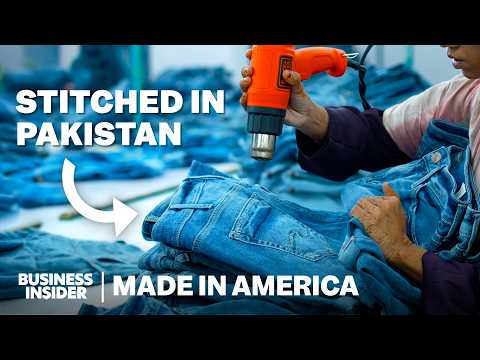
- Crescent Bahuman Limited, a Pakistani textile firm, leverages massive scale to produce both raw fabric and finished jeans for global brands like Levi’s and Target, creating a structural cost and response-time disadvantage for US mills.
- Mount Vernon Mills has abandoned the mass-market race to specialize in high-margin, technical products like flame-resistant denim, which gains value from chemical integrity rather than commodity pricing.
- Management at the Georgia plant is betting on selvage denim—a heritage fabric woven on vintage looms—as a status symbol, citing that consumer wait-lists can stretch two years while brands like Levi’s charge nearly double for these specific lines.
- US manufacturing faces a significant labor mismatch, as survey data shows 80% of Americans support domestic jobs in principle, yet only 25% are willing to perform that labor themselves, forcing mills to adjust schedules to 4-day workweeks to retain staff.
- The mill’s strategy relies moveably on preserving nearly lost technical knowledge, requiring the recruitment of international specialists to repair aging machinery that remains commercially essential for premium product differentiation.
- Claims regarding the superior labor environment at foreign plants like Crescent Bahuman Limited remain entirely company-reported and lack independent, audited verification in the source material.
The 1 Minute Signal Take
The evidence suggests that a return to mass-market US denim production is economically implausible, making the premium-niche pivot a survival necessity rather than a choice. While the video successfully illustrates the technical hurdles of heritage manufacturing, it sidesteps a deeper analysis of whether these niche markets are large enough to sustain long-term domestic industrial employment. Watch this for the rare footage of vintage looms and the technical explanation of flame-resistant fabric; skip if you only need the market-positioning argument, as that is fully captured in the summary.
Time saved:
Channel: Business Insider