Building Engine v2: How LangChain approaches agent improvement

Video thumbnail: Building Engine v2: How LangChain approaches agent improvement
Oct 7, 202620m 19s video lengthLangChain

The Signal

LangChain is evolving its "Engine" product from a passive trace-triage tool into an autonomous agent-engineering loop that proactively repairs and red-teams LLM deployments. By shifting from local trace analysis to cross-trace trend detection and verified code deployment, the team aims to automate the maintenance of complex agentic workflows while reducing manual developer toil. The central tension lies in whether these autonomous improvements and benchmark-driven performance claims translate to reliability across disparate real-world production environments.

The Case

Workflow Automation

  • Engine now implements a "validated fixes" loop: it reproduces a bug on production, generates a fix in a preview deployment, verifies the fix against the original failing inputs, and runs broader regressions to ensure system stability.13:50
  • The product features a "red teaming" capability that uses system prompts and harness context to proactively generate adversarial inputs, attempting to break agents before they are deployed to end users.16:09

Detection & Scale

  • V2 expands capabilities beyond identifying single-trace failures like hallucinations or looping tool calls; it now detects cross-trace patterns, such as model swaps that cause sudden spikes in tool-call counts even when cost and latency remain stable.11:58
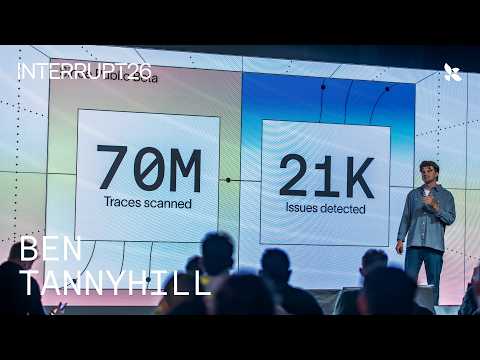
  • Since its May 2026 launch at Interop, LangChain reports the platform has scanned over 70 million traces and generated 21,000 issues.1:32
  • The team utilizes an internal "meta Engine" that runs the product against its own traces, using Slack-based feedback loops to identify and refine Engine’s own performance.6:02

Evaluation & Strategy

  • LangChain claims a 2x improvement in error identification against IssueBench, though this figure lacks independent methodological verification in the provided source.8:19
  • Because Engine performs distinct tasks—from trace clustering to regression monitoring—the team maintains task-specific benchmarks to avoid hiding regressions in aggregate scores.3:22
  • Future V3 plans target broader architectural optimizations, including recommending wholesale model replacements or harness adjustments when current configurations prove too bulky or expensive.18:42

The 1 Minute Signal Take

LangChain is aggressively moving toward agentic self-optimization, banking on the idea that autonomous verification loops can replace the manual grind of debugging LLM traces. While the operational scale of 70 million traces suggests strong internal uptake, the transition from local bug-fixing to system-wide model recommendations remains a high-ambition roadmap that has yet to prove its generalization across diverse user environments.

Pro Analysis

Why It Matters

Agent reliability remains the primary hurdle for enterprise adoption. LangChain’s approach treats agent engineering as a software reliability problem, shifting the focus from 'prompt tuning' to systematic verification and regression testing.

Strategic Implications

By building tools that can automate fix generation and validation, LangChain is positioning itself as the 'CI/CD of the AI era.' This creates significant vendor lock-in, as teams that integrate their deployment pipeline into Engine’s verification workflow become structurally dependent on the platform’s methodology.

Evidence & Hype Audit

  • Strengths: The workflow logic—reproduce, preview, verify, regress—is standard for high-quality software engineering and highly applicable here.
  • Weaknesses: The '2x better' benchmark claim lacks transparent methodology or external validation, placing it in the realm of promotional signaling rather than rigorous empirical proof.

Counterarguments

Critics might argue that agent behavior is too non-deterministic for these automated pipelines to ever be fully trusted. If the 'validated fix' is generated by an LLM, the system may simply be trading one hallucination for another, potentially introducing subtle, harder-to-detect logic errors.

Who Should Care

  • AI Engineers: To understand how to structure their own evaluation pipelines.
  • Engineering Managers: To assess if they should build in-house testing tools or adopt vendor-managed frameworks.

What To Do Next

  • Audit your agent's top three failure modes.
  • Build a small dataset of 'known-breaking' production traces.
  • Define task-specific benchmarks rather than relying on global performance scores.
  • Implement a 'preview branch' logic for any agent updates before they hit production.
  • Review your agent's cost-to-performance ratio; check if a smaller, 'dumber' model performs the same task with less latency.
Time saved:17m 3s

Share this

Tags

Written by: 1 Minute Signal Editorial Team