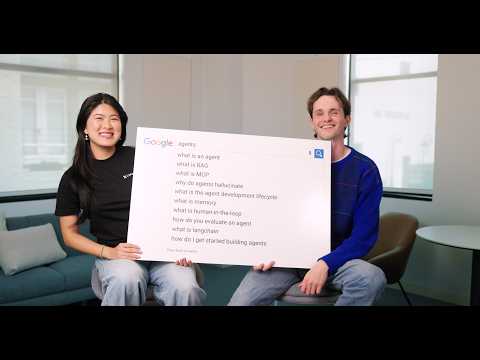
The LangChain Team Answers the Most Searched Questions About Agents

Video thumbnail: The LangChain Team Answers the Most Searched Questions About Agents
Jul 14, 20269m 10s video lengthLangChain

The Signal

Effective agent-based systems require moving beyond demo-stage prototyping toward a rigorous, continuous production lifecycle. While the core agentic mechanism—a loop of large language models using tools—is inherently powerful, multi-step execution risks compounding errors. The central challenge for developers is maintaining reliability through automated, persistent verification rather than simple intuition.

The Case

The Lifecycle and Risks

  • Agents succeed or fail based on a four-phase lifecycle: build, test, deploy, and monitor. The primary pitfall is the transition from fun, single-query demo building to production environments, where agents can fail silently for weeks without proper oversight.2:33
  • Hallucinations are a model-level reality, but agents amplify the impact; a single error in step two propagates through every subsequent tool call, poisoning final outputs.1:53
  • Continuous evals — testing that runs automatically whenever you tweak a prompt or swap a model — are framed as the only reliable way to catch regressions, as real-world agent inputs are too variable for traditional software testing methods.5:20

Implementation and Tools

  • LangChain — a company that transitioned from an open-source library to a full-stack development platform — categorizes agent builders by technical comfort: developers use 'Deep Agents' for code-based planning while no-code users utilize 'Fleet' to build via natural language.7:37
  • The Model Context Protocol (MCP) functions as a standardized connection layer for tools and data, designed to replace the need for bespoke integrations between agents and external databases.1:27
  • Human-in-the-loop design should be selective rather than total: teams must reserve human approval checkpoints only for high-stakes actions, allowing the agent to handle routine tasks autonomously to maintain efficiency.3:39
  • LangSmith — the company's platform for observability and reliability — is presented as framework-agnostic, meaning it is designed to trace, test, and monitor agents regardless of the underlying LLM or orchestration code.8:36

The 1 Minute Signal Take

Production agent reliability is not achieved through prompt engineering alone, but through the integration of continuous tracing and automated evaluation. If you are building for production, avoid the temptation of 'vibe checking' your agent's reasoning and instead invest in the infrastructure needed to catch compounding errors before they hit your end users.

Pro Analysis

Why It Matters

The transition from 'LLM as a chatbot' to 'Agent as a worker' moves the bottleneck from intelligence (model quality) to r...

Full analysis always available on Pro.

Time saved:7m 14s

Share this

Tags