
Back to Feed
Kubernetes vs. OpenShift: Choosing DevOps and CI/CD Workflows
The Signal
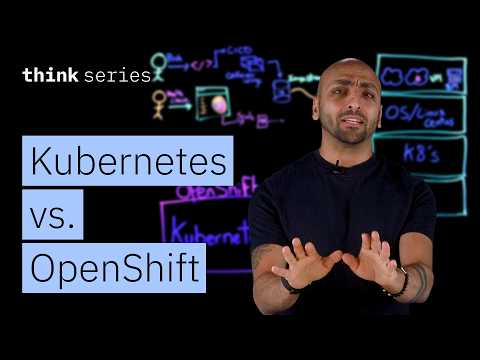
Kubernetes is the foundational container orchestration system, while OpenShift is a pre-integrated platform layer built on top of it. The central tension is between the control of assembling your own infrastructure stack using only Kubernetes versus the ease of adopting OpenShift’s built-in workflows and management consoles, which the narrator asserts simplifies DevOps but remain purely promotional claims rather than demonstrated benchmarks.
The Case
- OpenShift functions as an abstraction layer for Kubernetes, packaging core scheduling capabilities with additional operators, automated workflows, and ready-to-use configurations.
- The workflow simplifies the path from code to production for developers: a push to the codebase triggers a pipeline that builds a container image, registers it, and deploys it via an internal image stream.
- Portability is a core feature, as OpenShift is designed to operate consistently across diverse environments including public and private clouds, VMware, bare metal, and virtual machines.
- Operations are centralized within a web console, allowing IT teams to monitor cluster resources, perform cluster management, and troubleshoot issues from a single interface.
- Scaling operations are described as a straightforward process of either adding physical machines to the cluster or increasing the number of application pods to handle load.
- The narrator’s claim that Kubernetes alone requires excessive manual work to manage security and pipelines is a broad generalization, and their assertion that OpenShift is universally faster or simpler is presented without supporting data or context.
The 1 Minute Signal Take
The video serves as a high-level marketing pitch for OpenShift, clearly outlining the functional differences between base Kubernetes and the OpenShift platform. It is useful for understanding the intended value proposition for DevOps teams but lacks the technical nuance or comparative evidence required to make an informed architectural decision. Skip it if you are looking for an objective performance comparison; it is best viewed only if you need a quick, conceptual orientation to how OpenShift positions its toolsets.
Time saved:
Tags
Back to Feed