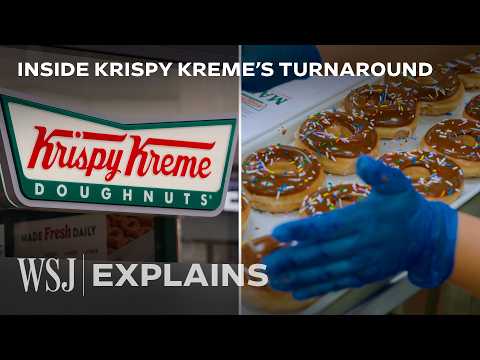
Why Krispy Kreme Can’t Fully Automate Its Donuts | WSJ

Video thumbnail: Why Krispy Kreme Can’t Fully Automate Its Donuts | WSJ
Jul 6, 20266m 13s video lengthThe Wall Street Journal

The Signal

Crispy Kreme is retreating from aggressive, growth-at-all-costs expansion to focus on profitability and a capital-light, franchise-heavy model. While the company heavily uses automation for standardized base-donut production, it remains structurally dependent on human labor for decorating and complex finishing, as current robotic technology creates quality risks that threaten their premium brand proposition.

The Case

Automation and Labor Constraints

  • Base donut production is largely mechanized across lines producing 200 to 400 dozen units per hour, yet 10–15% of the company's 6,500-strong U.S. workforce remains dedicated to manual decoration.2:18
  • Management admits automation efforts for finishing have failed; in prior pilots, glaze entered robot joints and the machinery lacked the agility to handle variable designs without damaging the product.0:52
  • Decorators currently handle up to 50 dozen donuts per hour, providing the judgment and quality control necessary for seasonal limited-time offers where demand spikes inconsistently.

Strategy and Financial Reset

  • The company implemented a formal turnaround in mid-2025 to address profitability and balance-sheet issues that deepened after its partnership with McDonald’s collapsed.4:53
  • While the McDonald’s deal provided initial reach, management claims the revenue stream proved unsustainable due to operating conditions that were not optimal for the brand.3:42
  • The current turnaround has yielded a 250-basis-point margin improvement, with leadership forecasting 2–4% systemwide sales growth and a push toward a more capital-light franchising model.
  • Despite broad market concerns regarding GLP-1 weight-loss drugs, leadership maintains demand is driven by a consistent consumer desire for "fresh and indulgent" treats, framing their challenge as brand-relevance rather than a category-level health crisis.5:40

The 1 Minute Signal Take

Crispy Kreme is a classic example of an industrial producer hitting a hard ceiling on automation due to product complexity rather than technical inability. Their pivot toward franchising and margin efficiency suggests they are moving away from brute-force distribution to defend the premium quality that justifies their price point.

Pro Analysis

Why it Matters

This case study illustrates the 'automation ceiling' in food manufacturing, where the pursuit of extreme efficiency meets the irreducible complexity of product design. It serves as a reminder that human labor is not always baggage; often, it is the fundamental quality control layer for brand differentiation.

Strategic Implications

Krispy Kreme's pivot from growth to optimization reflects a broader corporate shift post-2023. By offloading capital intensity through franchising and focusing on 'turnaround economics,' they are attempting to preserve the premium nature of their product while cleaning up a balance sheet damaged by unsustainable expansion experiments.

Evidence & Hype Audit

This content is highly grounded in operational reality. The inclusion of specific failure modes ('glaze in the joints') prevents this from being vague corporate marketing. However, the company's claim that their product remains perfectly suited for a GLP-1 era is an optimistic belief, not a data-backed certainty.

Counterarguments

Critics might argue that the failure to automate is a failure of engineering vision rather than a market reality. If a competitor eventually masters 'soft-touch' robotics, Krispy Kreme’s heavy reliance on a 15% manual labor force could become a massive structural cost disadvantage.

Role-Specific Takeaways

  • Operations Leaders: Prioritize automation on the 'coarse' or 'base' stages of production; leave finishing as a manual task until robotics handle fluid-based environments better.
  • Strategists: Sustainable revenue is superior to channel proliferation. The McDonald's failure is a prime example of high-volume distribution lacking the economic quality of retail operations.

What to do next

  • Audit manual labor segments to identify which tasks add brand value vs. those that just add cost.
  • Reassess capital-intensive partnerships to determine if the variable costs align with long-term margin goals.
  • Monitor the 250 bps margin trend to see if it sustains over the next four quarters.
  • Explore modular automation that enhances human output rather than trying to perform a full manual replacement.
Time saved:3m

Share this

Tags