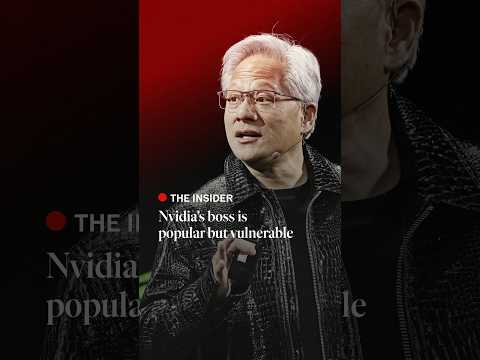
Nvidia’s boss is popular but vulnerable | The Economist

Video thumbnail: Nvidia’s boss is popular but vulnerable | The Economist
Sep 7, 20262m 44s video lengthThe Economist

The Signal

Jensen Huang, the Taiwan-born CEO of Nvidia, enjoys immense celebrity-level adulation in Taiwan that transcends tech circles. His status serves as a focal point for Taiwanese national pride and economic optimism, reflecting the island's central role in the global AI supply chain. This prestige, however, underscores a complex geopolitical reality where Nvidia’s deep reliance on Taiwanese manufacturing renders the company an unavoidable diplomatic intermediary between the United States and China. The core tension lies in whether this industrial indispensability acts as a protective 'silicon shield' or merely increases Taiwan’s strategic vulnerability.

The Case

Industrial and Economic Stature

  • Huang is widely viewed in Taiwan as a 'local boy made good,' with his fame bolstered by the fact that the TAIEX stock index has risen approximately 90% this year, largely driven by the AI sector.
  • Nvidia does not manufacture its own chips, relying entirely on TSMC—a Taiwan-based semiconductor giant—to produce its hardware, confirming that Taiwan is not just a peripheral supplier but a core node in Nvidia’s production model.0:52
  • The speaker claims that 80% to 90% of the world’s advanced-chip capacity is currently concentrated in Taiwan, a specific dependency that makes the island indispensable to the global economy.1:13

Geopolitical Dynamics

  • This concentration of manufacturing capability is described as a 'silicon shield,' an unproven but widely discussed theory that the global reliance on Taiwan's chips incentivizes foreign powers to maintain the island's stability.
  • Beyond their corporate role, Huang and Nvidia have become diplomatic intermediaries in the friction between the US and China, with the speaker noting that their involvement in these geopolitical tensions is likely unavoidable rather than a purely strategic choice.2:19

The 1 Minute Signal Take

Huang’s celebrity in Taiwan is inseparable from the island's unique position as the world's singular source for advanced semiconductor fabrication. While this dependence currently provides Taiwan with significant global leverage, it simultaneously locks the nation into the center of high-stakes technology wars between superpowers.

Pro Analysis

Why It Matters

This content highlights the transition of tech executives from mere business managers to central geopolitical players. As artificial intelligence becomes the primary driver of national power, companies controlling the hardware supply chain—like Nvidia—are inevitably drawn into the diplomatic orbit of major nations.

Strategic Implications

For investors and policymakers, this signals that geographic concentration in the semiconductor supply chain is not just an operational risk; it is a fundamental pillar of modern international relations. The 'silicon shield' concept suggests that economic integration has become the primary defense mechanism against regional conflict, making the supply chain a diplomatic asset.

Evidence & Hype Audit

While the content is highly insightful, it relies on observational rhetoric (the 'Taylor Swift' comparison) and broad generalizations regarding geopolitical outcomes. The 80-90% concentration figure is a powerful, though illustrative, metric that warrants deeper verification against actual industry production data.

Counterarguments

The 'silicon shield' theory is often debated; critics argue that if a competitor or a state actor believes they can capture the manufacturing infrastructure intact, the shield could conversely become a target, incentivizing aggression rather than stability.

Who Should Care

  • Geopolitical Strategists: To track how corporate supply chain dependencies impact statecraft.
  • Tech Investors: To monitor the risk associated with extreme manufacturing concentration in sensitive geopolitical regions.
  • Diplomats: To understand how non-state actors (CEOs) are shaping international relations.

What to Do Next

  • Map the geographic diversity of your firm's critical dependencies.
  • Analyze the progress of US-based semiconductor fabrication plants to gauge future supply chain resilience.
  • Evaluate the potential impact of sudden shifts in the US–China relationship on hardware availability.
  • Research the 'silicon shield' hypothesis to understand the nuances of economic-based deterrence.

Share this

Tags

Written by: 1 Minute Signal Editorial Team