
Strategic Implications
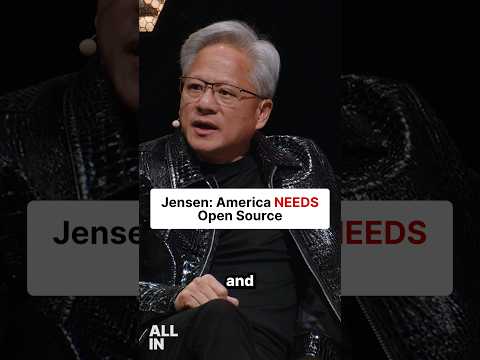
This perspective represents a distinct pro-open-source lobbying position that shifts the goalpost from 'who has the best model' to 'who has the most widespread application.' By framing open models as infrastructure—like electricity or Linux—the speaker attempts to bypass national security concerns related to China by focusing on the utility of the 'fork' rather than the 'origin.'
Evidence & Hype Audit
This content is highly speculative and promotional. It relies on massive, unsourced figures ($400B in venture funding) and presents complex geopolitical and technical challenges as solved problems (e.g., the assumption that a model is 'yours' upon download ignores licensing, hardware compute requirements, and safety governance). It is effectively a persuasive argument rather than a technical or analytical report.
Counterarguments
Critics would argue that 'downloading' a model does not equate to 'owning' it. Unlike static software like Linux, large AI models require massive compute infrastructure to train, fine-tune, and run efficiently. Additionally, closed-model proponents would argue that safety, alignment, and long-term security cannot be guaranteed if the model weights are essentially public, regardless of where those weights originated.
Who Should Care
- Policy Makers: To understand the push for open-source AI support against restrictive export controls.
- Founders/CTOs: To evaluate whether building on open models offers a more sustainable long-term defensive moat than API dependence.
- Investors: To gauge the veracity of the claim that 80% of AI-native startups are choosing open-source architectures.
What To Do Next
- Verify the claim that 80% of AI-native firms rely on open models against recent industry reports.
- Assess the cost-benefit of open-source fine-tuning versus closed-source API integration for your specific use case.
- Investigate the legal and security limitations inherent in 'forking' high-compute proprietary models.
- Evaluate how your organization differentiates between 'proprietary' competitive advantages and 'open-infrastructure' utility.