Jeff Dean: The 1% Rule for Building in AI

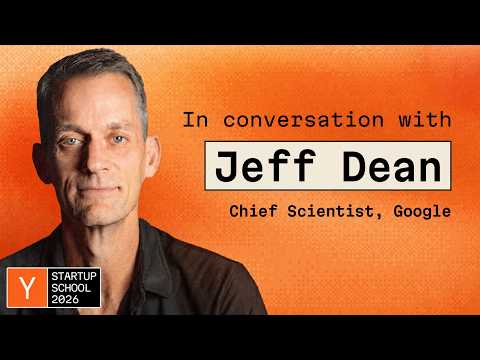
Video thumbnail: Jeff Dean: The 1% Rule for Building in AI
Jul 30, 202657m 7s video lengthY Combinator

The Signal

AI advancement is shifting from raw model scaling to systems-level orchestration, as long-running agents, custom tools, and context-heavy workflows become the real bottlenecks. Jeff Dean, a veteran Google researcher who built MapReduce and the TPU, argues the most valuable skill now is taste: choosing which problems to delegate to agents and defining clear specifications to guide them. Success in AI is increasingly found by identifying hidden bottlenecks and re-architecting systems from first principles rather than just improving model capacity.

The Case

Systems and Orchestration

  • Progress now relies on "context engineering"—assembling retrieval, memory, tools, and multi-agent coordination—because the model itself is only one part of the solution.16:16
  • Long-running agents often fail after roughly 10 interactions as tasks drift off-distribution, a limitation currently mitigated by using skills, hints, and multi-agent search to keep them on track.22:16
  • Moving data is roughly 1000x more energy-expensive than calculating it, which drives the reliance on batching; future hardware must solve this data-movement bottleneck to enable low-latency, agentic AI.12:15

Bottlenecks and Breakthroughs

  • Fast evaluators can collapse scientific loops; for example, a neural approximation to a quantum chemistry simulator was 300,000 times faster than the original engine.44:28
  • Historical breakthroughs like the TPU—a specialized chip for low-precision linear algebra—succeeded because they identified a clear hardware-cost bottleneck in speech recognition that CPUs could not cost-effectively solve.6:10
  • Distillation techniques were initially rejected by academic reviewers as "unlikely to have significant impact" but later became industry-standard, including for the development of Gemini Flash models.48:04

Strategy for Founders

  • The most durable startup opportunities exist where general-purpose models fail nearly completely (success rates near 0–1%) rather than niches where they already work reasonably well.28:22
  • Scarce human advantage is shifting toward "taste": the ability to write crisp specifications that agents can execute, and the judgment to anticipate which problems will matter 12 months out.34:03

The 1 Minute Signal Take

Do not fixate on the raw capability of the foundation model, as the real leverage lies in building the orchestration layers and specialized evaluators around it. If you are building, prioritize domains where unique data access provides a moat that general models cannot cross.

Pro Analysis

Why It Matters

This synthesis dismantles the current hype cycle surrounding 'AGI' by grounding it in pragmatic systems engineering. It t...
Full analysis always available on Pro.

Time saved:55m 11s

Share this

Tags

Written by: 1 Minute Signal Editorial Team