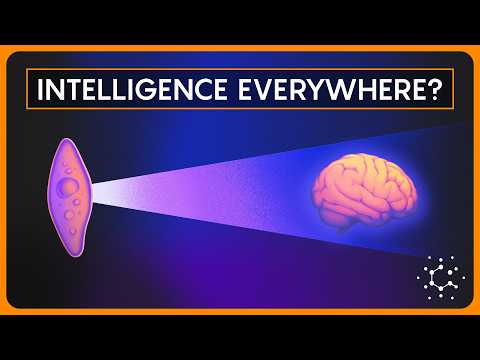
What If Intelligence Doesn't Need a Brain?

Video thumbnail: What If Intelligence Doesn't Need a Brain?
Jun 20, 20268m 1s video lengthQuanta Magazine

The Signal

Intelligence is not a proprietary feature of brains or neurons, but a spectrum of goal-directed problem-solving across all biological substrates. Researchers now argue that systems at the scale of cells, tissues, and potentially molecular networks exhibit agency, making intelligence a matter of variable competency rather than a binary switch. This framework challenges human-centric biases by demanding experimental proof of intelligent behavior in unfamiliar, non-neural bodies.

The Case

  • Intelligence is defined as the competence to reach a goal by different means, a functional definition that allows researchers to treat plant, cellular, and tissue-scale behavior as legitimate problem-solving.1:38
  • The lab uses a "cognitive light cone" tool to map intelligences by the scale of their goals, memory, and predictive reach, comparing something as small as a bacterium's sugar-gradient pursuit to human-scale financial market goals.2:16
  • Regenerative biology serves as primary evidence: when an amphibian limb is amputated, the remaining cell collective works to restore the original anatomical pattern, acting like a thermostat maintaining a homeostatic set-point.3:21
  • Tadpoles engineered with eyes placed on their tails demonstrate immediate visual function, a finding the speaker asserts as proof of an innate, pre-existing capacity for sensory-motor reconfiguration that does not require evolutionary time to calibrate.5:07
  • While the lab’s experimental results in cell patterning remain grounded in current biology, the speaker pushes for more radical empirical testing, including the question of whether molecular networks or even atmospheric systems like hurricanes can be trained.6:46
  • Epistemic caution: claims asserting "exactly the same" bioelectric processes in cells as those found in neural brains are strong extrapolations that lack independent verification within the provided research.4:02

The 1 Minute Signal Take

The speaker’s move toward a substrate-neutral, experimental definition of intelligence is a productive step away from anthropomorphic confusion, though their appetite for extending cognitive labels to molecules and weather is currently a speculative hypothesis rather than an established scientific result. Watch this for the clear explanation of how regenerative systems demonstrate goal-seeking behavior, but separate that documented competency from the speaker’s broader, more radical assertions.

Pro Analysis

Strategic Significance:

  • By shifting the definition of intelligence from 'neural computation' to 'goal-directed competency,' research can unlock new ways to treat cancer, repair organs, and design biological machines. It commoditizes 'intelligence' as an engineering parameter rather than a mystical human quality.

Who Should Care:

  • Biological engineers, synthetic biologists, and AI researchers interested in non-silicon-based cognitive architectures, as this framework provides a blueprint for leveraging natural cellular 'problem-solving' for complex tasks.

Contrarian Takeaway:

  • We may find that sophisticated problem-solving is not a biological 'luxury' evolved for survival, but a fundamental emergent property of matter that can be harnessed in systems currently labeled as 'inanimate'.
Time saved:5m 46s

Share this

Tags