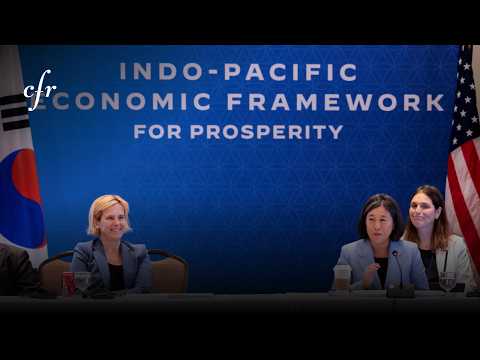
IAF Summer Series: U.S. Policy and the Indo-Pacific

Video thumbnail: IAF Summer Series: U.S. Policy and the Indo-Pacific
Jul 27, 202659m 7s video lengthCouncil on Foreign Relations

The Signal

U.S. Indo-Pacific policy is shifting from broad strategic coordination to transactional, issue-specific bargaining. While Japan is accelerating defense integration despite delayed arms deliveries, India and ASEAN are diversifying their economic and energy ties to hedge against American unpredictability. The central tension is whether these new linkages harden regional security or fracture it through competing interests.

The Case

Japan and Security

  • Japan has hit its 2% GDP defense-spending target two years early, yet the Pentagon is delaying the delivery of 400 Tomahawk missiles to replenish stockpiles depleted by operations against Iran.6:07
  • Despite this delay, Japan remains the most aligned partner because it lacks a viable security alternative while facing China’s 2,000+ long-range missiles.7:53
  • The country has effectively moved to remove long-standing restrictions on defense exports, enabling the transfer of retired naval vessels to partners like the Philippines and Indonesia.4:53

ASEAN and Energy

  • Southeast Asia faces an acute energy shock from Middle East instability, leading several ASEAN members to pursue alternatives like nuclear, renewables, and engagement with China or Russia.12:03
  • Internal consensus remains the region's biggest hurdle, though notable bilateral moves—such as the new strategic agreement between Vietnam and the Philippines—signal increased pushback against Chinese South China Sea claims.14:22
  • U.S. initiatives, including the regional supply-chain support labeled "Paxilica" focused on Subic Bay, aim to bolster maritime awareness and technology transfer, though regional hedging limits full alignment.14:55

India and Trade

  • U.S.-India relations have entered their most turbulent period in 25 years, marked by an aggressive tariff structure where India faces a cumulative 50% tariff burden following disputes over Russian oil purchases.19:22
  • While an interim trade agreement was reached in February 2026, the relationship remains in a volatile gray area where further commercial success depends on ongoing Section 301 negotiations.21:40
  • India’s ambitious AI trajectory is governed less by domestic capacity than by U.S. export-control policy on high-end AI chips, creating a significant bottleneck for the private-sector-led buildup.43:20

The 1 Minute Signal Take

The era of unconditional U.S.-led strategic cohesion in the Indo-Pacific is over. Partners are now calculating American reliability in real-time, meaning the U.S. must accept a more fractured, multi-aligned region where security cooperation is increasingly tied to specific, often difficult, trade and energy concessions.

Pro Analysis

Why It Matters

This content marks a shift from the 'pivot to Asia' rhetoric of the early 2020s to a 'managed friction' reality in 2026. The U.S. is effectively treating its Indo-Pacific allies as distinct assets for specific functional purposes (security, tech, energy) rather than monolithic bloc members. This is fundamentally changing the calculus of every regional capital.

Strategic Implications

The reliance on coercive trade tools and supply-chain bottlenecks suggests the U.S. is prioritizing short-term domestic industrial and military recovery over long-term strategic goodwill. While this may achieve specific tactical goals (e.g., burden-sharing from Japan), it risks creating permanent 'hedging' incentives across Southeast Asia, where states may view the U.S. as a reliable security provider but an unpredictable economic partner.

Evidence & Hype Audit

  • Transparency: The speakers distinguish clearly between settled policy (e.g., delivery delays) and internal debates (e.g., whether the India-US relationship has fundamentally broken).
  • Limitations: Some statistics presented (the 80% energy dependency figure) appear to be general estimates rather than verified macroeconomic data. Readers should weigh these as qualitative indicators rather than ground truth.

Counterarguments

Critics might argue that the 'transactional' nature of these alliances is a sign of maturity. Historically, U.S. policy in the region was often characterized by vague promises; the current shift toward concrete deliverables—however painful—might actually result in a more honest and sustainable long-term regional framework.

Role-Specific Takeaways

  • Security Analysts: Monitor the status of U.S. munitions production, as domestic stockpile levels are now directly altering regional deterrence timelines.
  • Trade Policy Specialists: Track Section 301 and pharma-tariff thresholds, which are now the primary drivers of political volatility with India.
  • Tech Sector Leads: Watch for 'digital harmonizing' initiatives in ASEAN, as these represent the next major barrier to entry for cross-border AI deployment.

What to Do Next

  • Verify the status of the February 2026 trade agreements.
  • Track the operational progress of Subic Bay tech-transfer projects.
  • Assess the viability of the ASEAN power grid initiatives.
  • Audit internal exposure to regional tariff volatility in current supply chains.
Time saved:55m 30s

Share this

Tags

Written by: 1 Minute Signal Editorial Team