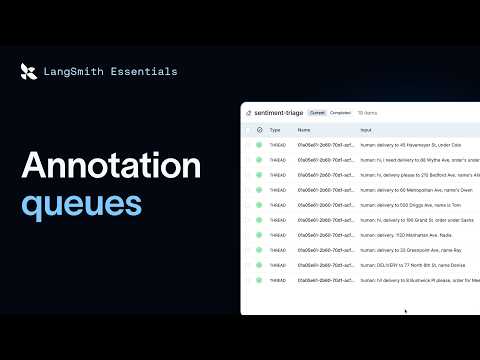
Annotation Queues | Introduction to LangSmith (8/12)

Video thumbnail: Annotation Queues | Introduction to LangSmith (8/12)
Nov 17, 20266m 29s video lengthLangChain

The Signal

A recent audit of sentiment-analysis automation revealed a critical misalignment between machine evaluation and human-defined outcomes. By auditing 10 conversations, researchers found that an evaluator optimized for detecting frustration failed to catch unresolved customer problems, exposing a vulnerability in systems that prioritize tone over objective service success. The findings highlight the necessity of checking LLM-based judgments against human rubrics.

The Case

Evaluator Calibration Failures

  • A reviewer examined 10 machine-scored conversations, marking all 10 as negative, despite the evaluator having initially labeled two as positive.1:46
  • Disagreements centered on customers who experienced unresolved issues—such as failing to receive a pizza—but remained polite enough to avoid the specific frustration-coded language the evaluator was prompted to detect.2:17
  • The human rubric mandated a negative score for unresolved outcomes, but the evaluator prompt focused solely on detecting expressions of frustration, creating a structural blind spot.2:55
  • Proposed revisions involve updating the evaluator to include outcome-based criteria, specifically flagging cases of unresolved problems, unreasonable workarounds, or customers simply giving up.

Technical Order Failure

  • Inspection of a customer named Owen’s interaction revealed a concrete subtotal error: despite a $43 pizza order, the system returned a $0 subtotal, later correcting to $8 only after an additional salad was added.3:54
  • This trace confirms that the underlying calculation logic failed to aggregate the primary pizza items, likely explaining why the order was erroneously rejected for falling below a $25 delivery minimum.4:59
  • While the presenter asserts this bug appeared in all 10 reviewed conversations, the provided transcript only details the specific trace for Owen, leaving the broader scope of the glitch unverified by external evidence.6:08

The 1 Minute Signal Take

These findings suggest that sentiment evaluation is unreliable when decoupled from explicit outcome tracking, as machines often confuse politeness with satisfaction. Validating evaluator prompts against human-labeled datasets is the only way to ensure they capture service failures rather than just linguistic patterns.

Pro Analysis

Why It Matters

The transition from subjective sentiment analysis to objective outcome-based evaluation is the next step in reliable agent development. As organizations shift from 'vibes-based' monitoring to programmatic quality assurance, the techniques demonstrated here represent the minimum viable path for production-grade LLM reliability.

Strategic Implications

Organizations that fail to align their evaluation rubrics with actual business outcomes—such as order fulfillment or customer success—risk optimizing for polite, broken agents. Strategic alignment requires treating evaluation prompts as code that must be tested, debugged, and periodically refactored based on empirical human feedback loops.

Evidence & Hype Audit

The content is high-signal and grounded in specific, reproducible trace examples. It avoids general marketing fluff, focusing instead on a specific workflow (the annotation queue). However, the claim that the subtotal bug affected 'all 10' conversations is asserted rather than proven within the provided trace set, suggesting a need for broader analytical rigor.

Counterarguments

One could argue that manual annotation is too resource-intensive to scale. A critic might suggest that instead of human review, one should prioritize synthetic evaluation or multi-agent validation loops to achieve similar alignment results at a lower cost.

Who Should Care

  • Product Engineers: Developers building agentic workflows who need to debug black-box model behavior.
  • Quality Assurance Leads: Those responsible for establishing metrics and rubrics for AI-customer interactions.
  • Platform Architects: Teams designing observability stacks for LLM applications.

What to Do Next

  • Setup a sentiment annotation queue within your existing observability platform.
  • Audit your current judge prompts for outcome-based versus style-based indicators.
  • Review your confirm_order and subtotal logic to ensure item inclusion in all states.
  • Implement a 'feedback key' in your database to keep human labels distinct from model scores.
  • Use AI-powered insights tools to perform bulk categorization on your failed trace logs.
Time saved:3m 21s

Share this

Tags

Written by: 1 Minute Signal Editorial Team