The last IMO problem AI could not solve

Video thumbnail: The last IMO problem AI could not solve
Sep 18, 202651m 56s video length3Blue1Brown

The Signal

International Math Olympiad 2025 Problem 6 was a notoriously difficult grid-tiling challenge that serves as a modern benchmark for AI reasoning. While recent models can now solve such problems via prompting, the core mathematical challenge remains proving that a specific construction of square tiles is indeed the global optimum. The video explores how this proof, grounded in permutation theory, reveals the distinction between raw computational problem-solving and the human-centric value of a "motivated explanation."

The Case

The Mathematical Proof

  • The challenge requires minimizing the number of tiles on a 2025 × 2025 grid so that each row and column contains exactly one empty square.4:09
  • A candidate optimal tiling construction for a grid of side length k² uses k² + 2k - 3 tiles, which for the IMO problem (k=45) provides the specific solution value.15:54
  • The proof strategy transforms the gaps into a permutation and partitions the grid into four regions using two boundary paths, defined by the Longest Increasing Subsequence (LIS) and Longest Decreasing Subsequence (LDS).28:16
  • By associating each tile with a unique highlighted edge and invoking the Erdős–Szekeres theorem—which establishes that LIS × LDS ≥ n for any permutation of length n—the proof confirms the lower bound of k² + 2k - 3 matches the construction.39:59

AI and Mathematical Understanding

  • DeepMind researcher Thang Luong suggests that AI systems struggled with this specific problem in 2025 because they lacked "patience"—the ability to fully grasp the structure before attempting a solution.3:10
  • The video argues that mathematical progress is not just about producing a correct proof, but about creating "motivated explanations" that make a solution feel discoverable and intuitive.48:43
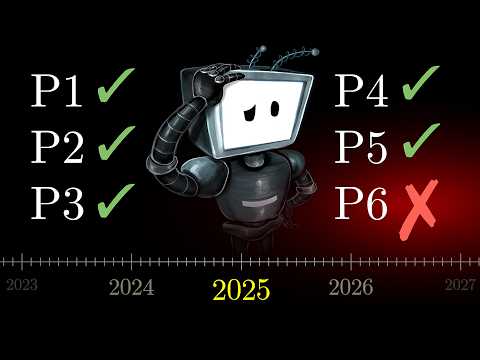
  • While 2024 benchmarks showed AI solving only 4 of 6 problems, 2026 reasoning models can now solve all six, shifting the focus from whether a model can solve a problem to whether it can contribute to mathematical understanding.2:25

The 1 Minute Signal Take

The transition of IMO problems from "AI-proof" challenges to solvable benchmarks highlights that machines are rapidly mastering raw proof-generation. The real remaining gap for AI is not in technical execution, but in the higher-order task of synthesizing human-readable, motivated mathematical narratives.

Pro Analysis

Why It Matters

This content serves as a high-fidelity benchmark for the current state of artificial intelligence in non-linear, creative...
Full analysis always available on Pro.

Time saved:49m 59s

Share this

Tags

Written by: 1 Minute Signal Editorial Team