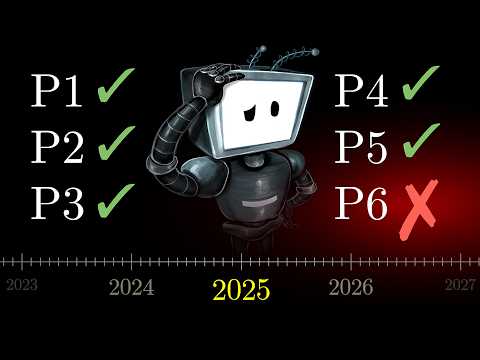
The last IMO problem AI could not solve

Video thumbnail: The last IMO problem AI could not solve
Sep 18, 202651m 56s video length3Blue1Brown

The Signal

International Math Olympiad 2025 Problem 6 was a notoriously difficult grid-tiling challenge that serves as a modern benchmark for AI reasoning. While recent models can now solve such problems via prompting, the core mathematical challenge remains proving that a specific construction of square tiles is indeed the global optimum. The video explores how this proof, grounded in permutation theory, reveals the distinction between raw computational problem-solving and the human-centric value of a "motivated explanation."

The Case

The Mathematical Proof

  • The challenge requires minimizing the number of tiles on a 2025 × 2025 grid so that each row and column contains exactly one empty square.4:09
  • A candidate optimal tiling construction for a grid of side length k² uses k² + 2k - 3 tiles, which for the IMO problem (k=45) provides the specific solution value.15:54
  • The proof strategy transforms the gaps into a permutation and partitions the grid into four regions using two boundary paths, defined by the Longest Increasing Subsequence (LIS) and Longest Decreasing Subsequence (LDS).28:16
  • By associating each tile with a unique highlighted edge and invoking the Erdős–Szekeres theorem—which establishes that LIS × LDS ≥ n for any permutation of length n—the proof confirms the lower bound of k² + 2k - 3 matches the construction.39:59

AI and Mathematical Understanding

  • DeepMind researcher Thang Luong suggests that AI systems struggled with this specific problem in 2025 because they lacked "patience"—the ability to fully grasp the structure before attempting a solution.3:10
  • The video argues that mathematical progress is not just about producing a correct proof, but about creating "motivated explanations" that make a solution feel discoverable and intuitive.48:43
  • While 2024 benchmarks showed AI solving only 4 of 6 problems, 2026 reasoning models can now solve all six, shifting the focus from whether a model can solve a problem to whether it can contribute to mathematical understanding.2:25

The 1 Minute Signal Take

The transition of IMO problems from "AI-proof" challenges to solvable benchmarks highlights that machines are rapidly mastering raw proof-generation. The real remaining gap for AI is not in technical execution, but in the higher-order task of synthesizing human-readable, motivated mathematical narratives.

Pro Analysis

Why It Matters

This content serves as a high-fidelity benchmark for the current state of artificial intelligence in non-linear, creative problem-solving. By focusing on a single, representative IMO problem, the analysis cuts through marketing noise to highlight the qualitative gap between pattern matching and structured reasoning.

Strategic Implications

The shift from 2025 failure to 2026 success underscores that we are entering an era of 'reasoning at scale.' The transition from needing specialized formal languages like Lean to using natural language prompting suggests that models are learning to internalize formal logic structures, potentially rendering entire classes of 'hard' human tasks trivial within months.

Evidence & Hype Audit

The content relies on a strong, verified mathematical proof as its anchor. The commentary on AI capabilities is observational and anecdotal, relying on internal company discussions (e.g., DeepMind) rather than controlled experimentation. It is highly trustworthy as a mathematical explanation, but its claims regarding AI psychology should be viewed as interpretive theories.

Counterarguments

Critics might argue that the 'patience' or 'beauty' narrative is a romanticization of what is simply a failure of model scaling or training data distribution. As models continue to scale, these 'human' traits may be revealed as emergent behaviors of larger parameter counts rather than a fundamental lack of machine 'spirit.'

Who Should Care

  • AI Researchers: To understand the structural limits of current reasoning models.
  • Mathematicians: To see a elegant reduction of a complex geometry problem.
  • Tech Strategists: To gauge the speed of AI progress in creative, non-trivial domains.

What To Do Next

  • Verify the permutation reduction to ensure the LIS/LDS inequality holds for all grid configurations.
  • Compare the 2025 IMO performance of contemporary models versus 2026 iterations to map the 'reasoning' trajectory.
  • Investigate the concept of 'motivated explanation' as a metric for model quality.
  • Reflect on which human intellectual tasks remain truly insulated from formalization.
Time saved:48m 30s

Share this

Tags

Written by: 1 Minute Signal Editorial Team