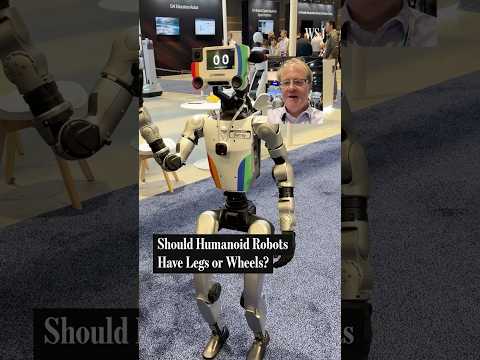
Which Are Better For Humanoid Robots: Legs or Wheels?

Video thumbnail: Which Are Better For Humanoid Robots: Legs or Wheels?
Jul 6, 20262m 1s video lengthThe Wall Street Journal

The Signal

The Automate Robotics Show in Chicago recently highlighted an unresolved architectural standoff in humanoid robotics: the choice between legs, which prioritize versatile interaction across complex terrain, or wheels, which favor stability and efficiency in structured commercial environments. This trade-off between mobility and flexibility remains a central, open-ended question for industrial robot deployment.

The Case

  • Wheels are framed as the superior choice for factories and warehouses where cart-based movement is common, utilizing a low center of mass to provide stable, efficient, and highly controlled motion.0:10
  • Legs are positioned as the more humanlike interface, better suited for navigating uneven terrain and performing tasks that require intuitive interaction, though the transcript frames this primarily as an operational design preference.0:41
  • Agility Robotics, the maker of the legged Digit robot seen previously at a South Carolina auto parts plant, chose legs to create a single flexible platform. Their CTO posits that this leg-driven design will eventually enable the robot to move from indoor floors to outdoor environments like beaches and trails.
  • Technical claims from both sides are often aspirational or rhetorically framed; for instance, the assertion that wheeled robots will not fall serves as a performance promise rather than a proven mechanical guarantee.
  • The piece concludes with the robot itself endorsing legs for their "wow factor," a playful anthropomorphic response that the narrator explicitly notes is a self-serving preference for a legged machine rather than an objective technical verdict.1:43

The 1 Minute Signal Take

There is no industry consensus on whether humanoid robots should have wheels or legs; the choice depends entirely on whether a firm prioritizes immediate industrial efficiency or future-focused environmental flexibility. Viewers should treat claims of future outdoor capability—such as walking on beach sand—as a high-reach design roadmap rather than a currently validated operating mode.

Pro Analysis

Why It Matters

The mobility debate is a proxy for the broader question of how we define a 'humanoid.' If a robot is designed merely to move boxes efficiently, it may never need legs. However, if the goal is to create a versatile agent that can navigate any human environment, the cost and technical complexity of legs become an inevitable investment. This video identifies the tipping point where infrastructure constraints meet robotic potential.

Strategic Implications

Businesses looking to deploy robotics must stop viewing mobility as a uniform feature. The 'efficiency vs. versatility' trade-off means that companies might need a heterogeneous fleet: wheeled units for structured facility tasks and legged units for dynamic, multi-environment operations. This increases the total cost of ownership.

Evidence & Hype Audit

The content relies on sound engineering principles related to center-of-mass stability and terrain navigation. However, the claims regarding outdoor performance (beaches/trails) for the Digit project are currently aspirational. The video successfully avoids over-promising, maintaining a balanced perspective that acknowledges the limitations of both designs.

Counterarguments

Critics of the legged approach might argue that 'flexibility' is a distraction from the reality of battery life and maintenance. Legs are mechanically far more complex and prone to wear than wheels, meaning the 'cost-per-movement' for a legged robot may remain higher for the foreseeable future, even if those robots are more capable.

Recommendations

  • Audit existing facility layouts to identify if stairs or uneven surfaces are actual bottlenecks or edge cases.
  • Assess whether tasks require human-like reach and interaction, which often justifies the complexity of legged platforms.
  • Monitor the durability data of legged systems in high-uptime commercial environments compared to mature wheeled platforms.
  • Define if the 'humanoid' form factor is a branding requirement or a functional necessity for your specific business workflow.

Share this