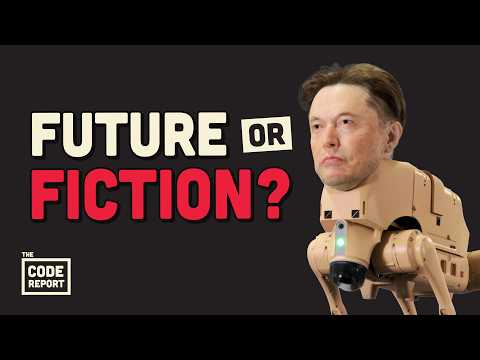
I spent 3 days at MIT... the robot hype is worse than you think

Video thumbnail: I spent 3 days at MIT... the robot hype is worse than you think
Aug 11, 20267m 2s video lengthFireship

The Signal

While viral humanoid robot demos—like Google DeepMind’s new Gemini Robotics system—show robots tying knots and cleaning rooms, experts remain skeptical of their near-term utility. The core tension lies between the impressive, curated visuals produced by startups and the underlying engineering reality that robotics, unlike LLMs, lacks a massive internet-scale dataset and requires high-stakes, continuous physical control.

The Case

Technical Bottlenecks

  • Locomotion is largely a solved problem, but reliable, dexterous hand manipulation remains the primary frontier; success rates for multi-finger tasks in demos reportedly range from 0% to 90%.2:32
  • Robotics requires emitting continuous joint angles and torques hundreds of times per second, making the system far less tolerant of the occasional errors that LLMs can absorb.3:59
  • Unlike text generation, robotics suffers from a structural data scarcity because no internet-scale corpus exists for physical world control, forcing reliance on simulation and synthetic data.4:23

Market Reality

  • High-profile humanoid demos from Tesla, Figure, and 1X are largely unverified spectacle, as these units are often not available for purchase, leaving their actual reliability unknown.5:16
  • Roboticists at MIT have suggested that a robot capable of replacing a maid remains 10 to several decades away, significantly dampening the "robot slave" narratives common in VC-backed marketing.0:40
  • The few accessible commercial options are limited, with the Chinese-made Unitree G1 representing one of the few models with a concrete, accessible entry point at $13,500.5:38

Sponsor Tech

  • OmniGenet provides an open-source meta-harness designed to orchestrate multiple AI coding agents, such as Claude Code and Codeex, within a secure, OS-level sandbox that avoids raw filesystem access.5:59

The 1 Minute Signal Take

Do not confuse polished demo videos with commercial readiness. True progress in humanoids is gated by physical reliability and dexterity, not by the scale of the software models driving them.

Pro Analysis

Why It Matters

This content challenges the prevailing narrative that AI-driven humanoids are nearing a mainstream inflection point. By contrasting the viral success of LLMs with the messy, high-stakes requirements of physical world interaction, it provides a necessary reality check for investors, developers, and policymakers.

Strategic Implications

Organizations banking on near-term humanoid labor face significant deployment risks. The reliance on 'Trust Me Bro' marketing videos suggests that capital allocation in the robotics sector is currently driven by speculative valuation rather than proven utility. Leaders should focus on specialized, constrained-environment automation rather than wait for the promised 'general-purpose' humanoid.

Evidence & Hype Audit

While the speaker offers expert-cited skepticism (MIT researchers), the analysis lacks empirical data or proprietary research, relying instead on observation and general principles. The claim that demos are designed solely to 'pump valuations' is an interpretive stance, albeit a common one in the industry.

Counterarguments

Critics might argue that the 'data problem' is already being solved through synthetic data and 'embodied' training environments (like those Google DeepMind is testing). Furthermore, the pace of hardware commoditization—exemplified by the $13,500 Unitree G1—may accelerate iteration cycles faster than current expert projections suggest.

Role-Specific Takeaways

  • Investors: Demand transparency on failure rates and real-world deployment metrics; move away from demo-based valuation.
  • Developers: Focus on simulation-to-real transfer and robust control policies rather than simple imitation learning.
  • Managers: Plan for long-term integration of task-specific robots; do not budget for general-purpose humanoids in the 1-3 year horizon.

What To Do Next

  • Verify the existence of publicly accessible benchmarks for any robot touted as a human replacement.
  • Evaluate the 'sim-to-real' gap in current project workflows.
  • Track the Unitree and AgiBot product releases as realistic indicators of price-to-performance trends.
  • Shift focus from vision-language-action (VLA) models alone to total system reliability in unpredictable environments.
Time saved:3m 57s

Share this

Tags

Written by: 1 Minute Signal Editorial Team