
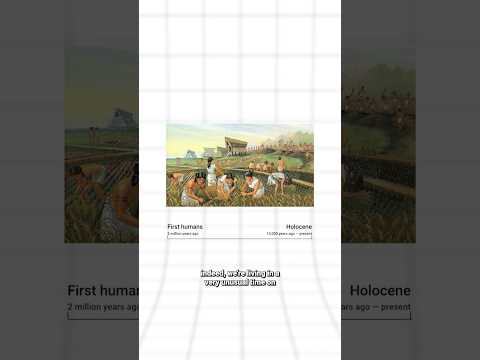
- Agriculture appeared independently across multiple distinct environments during the same climatic window.
- The Holocene represents a unique interval of climate stability that is rare over a two-million-year timeline.
- Most modern humans share a common ancestral lineage dating back to roughly 70,000 years ago, excluding specific groups like the Khoisan and rainforest hunter-gatherers.
- The delay in adopting farming underscores that structural adoption may rely more on environmental feedback loops than on the maturation of internal cognitive traits.
Channel: Dwarkesh Patel
Why Humans Waited 70,000 Years to Build Civilization - David Reich
This content explores the disconnect between human cognitive development and the unexpectedly late emergence of agriculture, pointing to climate stability as the primary catalyst.
Key Takeaways
- Humans possessed the necessary cognitive and intellectual capabilities for agriculture roughly 70,000 years ago.
- Despite this preparedness, farming only emerged approximately 11,000 to 12,000 years ago during the Holocene.
- The shift into an unusually stable climatic period after the ice age likely provided the necessary environmental conditions for farming to finally take root.
Talking Points
Analysis
Strategic Significance
The primary significance lies in identifying that human progress is likely 'environmentally gated.' Understanding this challenges the assumption that technological advancement is solely a function of human ingenuity or population growth; it suggests instead that external environmental stability is the required substrate for institutional complexity.
Who Should Care
Historians, evolutionary biologists, and policy strategists interested in existential risk will find this relevant. If our current civilizational complexity depends on a specific, stable climatic window, we must recognize that we are highly vulnerable to shifts in that baseline.
Contrarian Takeaway
Humanity's greatest achievements in agriculture and state formation may not have been the result of human brilliance, but rather the result of our ancestors finally living in an era that was 'boring' enough to allow for long-term planning.
Channel: Dwarkesh Patel