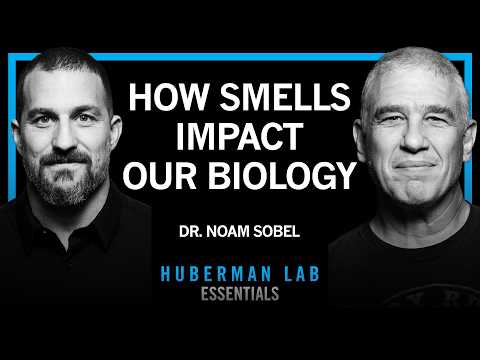
Essentials: How Smells Influence Our Hormones, Health & Behavior | Dr. Noam Sobel

Video thumbnail: Essentials: How Smells Influence Our Hormones, Health & Behavior | Dr. Noam Sobel
Oct 29, 202634m 56s video lengthAndrew Huberman

The Signal

Human olfaction functions as a major, underappreciated channel for social, endocrine, and behavioral regulation. Research from Noam Sobel, a professor of neurobiology, demonstrates that we unconsciously sniff ourselves and others to navigate relationships, modulate aggression, and influence physiological states. While these lab-based signals affect us, the field remains contested regarding whether these behaviors constitute universal pheromonal mechanisms or situational chemosensory cues.

The Case

Chemosensory Social Signaling

  • Handshakes reliably trigger unconscious face-touching and self-sniffing behavior, suggesting a mechanism for rapid, automatic comparison of self-scent against others.5:44
  • Click-based friendships—non-romantic pairs who feel an instant connection—show measurable body-odor similarity that predicts social judgments and affinity better than chance.10:03
  • Fear body odor is chemically detectable and contagious, triggering measurable sympathetic arousal in recipients who encounter the scent.14:38

Aggression and Endocrine Modulation

  • Hexadecanal, a compound abundant in baby heads, consistently reduces aggression in men while increasing it in women, a pattern researchers hypothesize may protect offspring.16:22
  • Emotional tears, although odorless, contain active chemosignals that lower free testosterone in men by roughly 14% and dampen activity in the hypothalamus and fusiform gyrus.21:51

Odor Digitization

  • Researchers have successfully used algorithmic frameworks to model odor perception and generate 'olfactory metamers'—distinct molecular mixtures that smell identical, such as a synthetic Chanel No. 5.26:56
  • Early proof-of-concept odor transmission over IP has been achieved, with 15 of 16 participants correctly identifying the scent of violets sent via remote synthesis.30:51

The 1 Minute Signal Take

Evidence across multiple controlled paradigms confirms that human chemosensation is behaviorally consequential, even if the evolutionary 'why' remains interpretive. While true 'digitized smell' is not a near-term consumer reality, the ability to model and reconstruct odors reveals that our sense of smell is far more sophisticated and influential than commonly understood.

Pro Analysis

Why It Matters

Our modern world is highly sanitized, leading to the collective delusion that humans are 'odorless' beings. This research matters because it reclaims a suppressed sense, demonstrating that smell is not a vestigial trait but a high-fidelity communication system that regulates everything from testosterone levels to social bonding. It shifts the human narrative from purely rational, verbal agents to biological beings still deeply influenced by chemical signaling.

Strategic Implications

For industries, the ability to generate olfactory metamers is a massive shift in flavor and fragrance chemistry, allowing for the creation of scents without traditional, scarce ingredients. More significantly, if metabolic health can be read through breath or body odor, we are approaching a 'continuous health monitoring' era where smart-bathroom devices could screen for early biomarkers of disease before clinical symptoms appear.

Evidence & Hype Audit

This content is grounded in high-quality, peer-reviewed lab studies using controlled paradigms (e.g., fMRI, Taylor Aggression Paradigm). The claims are largely evidence-based, though the leap to 'consumer-ready digitized smell' is speculative. The speaker is careful to distinguish between established mechanisms and evolutionary interpretations, which bolsters credibility.

Counterarguments

Critics might argue that human behaviors are so heavily driven by culture, language, and learned cognitive bias that chemical signals are 'noise' rather than drivers. Additionally, the 'evolutionary' explanations (e.g., baby heads influencing aggression) are post hoc narratives that, while compelling, lack the robust mechanistic proof of the experimental results.

Who Should Care

  • Biotech Researchers: For the diagnostic potential of scent sensors.
  • Product Designers: Understanding how subconscious sensory cues drive product affinity.
  • Clinicians: To monitor how patient stress or endocrine health manifests in odor signatures.

What to Do Next

  • Follow the progress of odor-primary identification to see which companies emerge in the 'digital scent' space.
  • Research current 'electronic nose' patents and startup activity in metabolic diagnostics.
  • Observe your own 'micro-habits' (like touching your face after a handshake) to build awareness of your sensory interaction patterns.
  • Explore the link between metabolic health and body odor to optimize personal wellness routines.
Time saved:31m 42s

Share this

Tags

Written by: 1 Minute Signal Editorial Team