
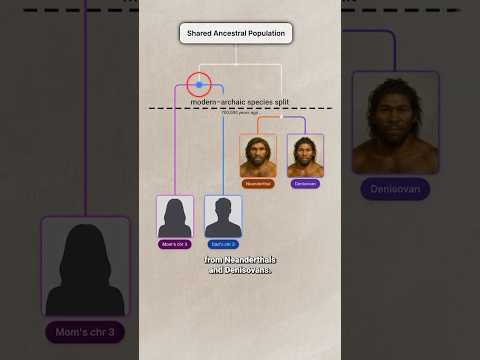
- Chromosome segments trace back to common ancestors shared millions of years ago, predating the divergence of Neanderthals.
- Ancient population variation ensures that modern humans do not share a single, uniform evolutionary path.
- Genetic similarity between individuals fluctuates across the genome depending on which specific ancestral population segment is being compared.
Back to Feed
Parts of Your DNA Are More Neanderthal Than Human - David Reich
This video details the ancient evolutionary origins of human DNA and explains why specific segments of our genome exhibit closer relatedness to Neanderthals than to other contemporary humans.
Key Takeaways
Talking Points
Analysis
Strategic Significance: This insight dismantles the myth of a discrete human genetic identity, highlighting that 'humanity' is defined by a complex, ancient overlap with other hominin lineages rather than a singular, isolated evolution.
Who Should Care: Biologists, anthropologists, and those interested in population genetics should care, as this challenges standard assumptions about genetic distance and ancestry.
Contrarian Takeaway: You are not a 'modern human' in a monolithic biological sense; you are a genomic chimera hosting segments of DNA that are technically more ancient and distinct from your peers than they are from extinct hominin species.
Back to Feed