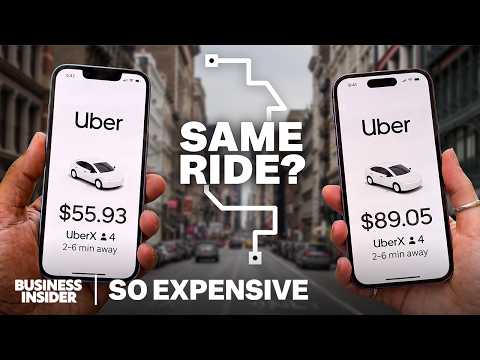
How Uber Uses AI To Charge You More

Video thumbnail: How Uber Uses AI To Charge You More
Aug 22, 202622m 57s video lengthBusiness Insider

The Signal

Uber’s transition to 'up-front pricing'—where algorithms dictate fares and payouts before a trip begins—coincided with the company’s first annual profit in 2023. While Uber maintains this model merely optimizes marketplace conditions, critics argue it functions as algorithmic price discrimination, raising rider costs while squeezing driver earnings through opaque, fluctuating fees.

The Case

Pricing Divergence

  • In controlled experiments, identical UberX requests made simultaneously from the same location produced materially different quotes, with spreads reaching nearly 21% in some tests.0:21
  • Consumer Reports, a nonprofit organization that tests consumer products, found median price gaps of up to 50% across 170 volunteers for identical routes, though Uber disputes the methodology and claims these results relied on discounted pricing.

Data and Transparency

  • Uber officially denies using personal data to personalize prices, asserting that patents describing behavioral tracking—such as typing speed or phone angle—are not used in pricing.0:57
  • A mandatory disclosure in New York states, "This price was set by an algorithm using your personal data," which Uber characterizes as a legal compliance measure limited strictly to location data rather than demographic profiling.7:22

Financial Mechanics

  • Len Sherman, a Columbia Business School professor, analyzed 50,000 trips and concluded that the system functions as 'algorithmic price discrimination' by estimating the maximum a rider will pay and the minimum a driver will accept.5:51
  • Drivers report severe pay volatility, citing examples like a $70.52 rider fare where the driver received only $25, and unpredictable insurance charges that fluctuated between $15 and $50 on the same route.13:45
  • Uber attributes higher rider costs to objective external factors including inflation, post-pandemic driver shortages, and rising government-mandated commercial insurance requirements.12:14

The 1 Minute Signal Take

The central tension lies in whether Uber’s pricing is a dynamic market necessity or a sophisticated tool for value extraction that masks its take-rate increases behind unavoidable 'outside costs.' While Uber’s profitability suggests the algorithm is effective at clearing the market, the lack of transparency invites skepticism, particularly as the model has become the standard template for the entire gig economy.

Pro Analysis

Why It Matters

The shift to up-front pricing represents a fundamental transition from platform-as-a-service to platform-as-an-extractor....
Full analysis always available on Pro.

Time saved:21m 8s

Share this

Tags

Written by: 1 Minute Signal Editorial Team