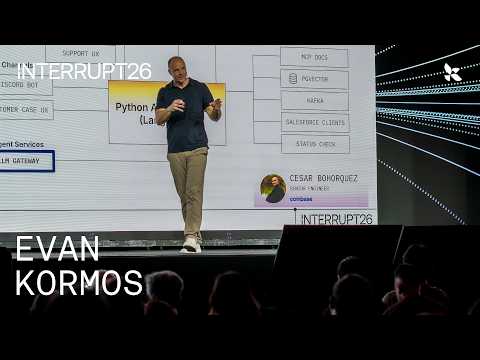
How Coinbase Builds Developer Support Agents | Interrupt 26

Video thumbnail: How Coinbase Builds Developer Support Agents | Interrupt 26
Jul 20, 202613m 55s video lengthLangChain

The Signal

Coinbase’s developer support team has evolved their workflow from ad-hoc Discord responses into a structured, observable system centered on agentic automation. The core tension lies in scaling support via AI while managing reliability and safety, forcing the team to build a "glass box" of traces and guardrails before fully automating public-facing responses.

The Case

System Architecture and Reliability

  • The support system now operates across Discord, Slack, and an internal React-based console, using an observable workflow where every agent action generates traces and metadata.3:45
  • Because remote Model Context Protocol (MCP) documentation tools proved unreliable for customer-facing inquiries, the team built a RAG (Retrieval-Augmented Generation) fallback based on a dedicated knowledge pipeline and vector database.4:58
  • The team implemented a layered safety design that combines deterministic guardrails, limited tool access, and lightweight-model evaluation to monitor outputs for accuracy and risk.7:08

Workflow and Operations

  • Every support task follows a rigorous intent-based lifecycle: defining intent, grooming with Claude Code and MCP tools, evaluating through cross-model review, and requiring human approval before production.9:31
  • Unexpected multilingual traffic in Discord surfaced as an immediate operational challenge, highlighting the need for broader language support that the team had not originally prioritized.11:48
  • Internal Slack triage channels turn Discord activity into actionable signals, allowing the team to use LangSmith trace data as a control plane for identifying systemic failures and refining agents.7:52

Development Philosophy

  • The internal Support Assistant remains in a read-only state for now, with human-in-the-loop features like "send customer response" being developed as the next phase of deployment.8:39
  • Evan Kormos, the speaker and a builder of Coinbase engineering teams, argues that developers must treat agent engineering as a distinct discipline that requires both product-focused engineering skills and a machine-learning mindset.12:47

The 1 Minute Signal Take

The team’s approach demonstrates that scaling support automation requires treating observability as a foundational prerequisite rather than a later integration. The key takeaway for similar builds is the necessity of a "glass box" architecture, where rigorous intent-based workflows and human-in-the-loop approvals replace blind faith in agent performance.

Pro Analysis

Why It Matters

This case study represents the 'next generation' of corporate generative AI: moving away from simple chatbots toward observable, auditable internal agentic systems. Coinbase is shifting from 'does this work' to 'how do we measure and control this at scale.'

Strategic Implications

  • Engineering Culture Shift: Treating agents as distinct architectural components rather than mere LLM wrappers allows for better debugging and iteration.
  • Risk Management: By forcing a 'read-only' posture initially and layering deterministic guardrails, companies can gain confidence in AI without risking immediate reputational damage.

Evidence & Hype Audit

  • Transparency: High. The team shares their stack (LangSmith, MCP, Python) and acknowledges where they failed (multilingual traffic, tool unreliability).
  • Bias: Self-reported. All assertions about velocity and 'extraordinary' results remain anecdotal. External verification is absent.

Counterarguments

  • Complexity Cost: Maintaining an observability layer, trace-controlled Slack bots, and RAG fallbacks requires significant overhead which may only be justifiable for large-scale operations.
  • Human Fatigue: 'Human-in-the-loop' systems can often lead to a false sense of security while creating high-friction bottlenecks that slow down actual resolution times.

Who Should Care

  • Engineering Managers: Those tasked with integrating LLMs into existing support or dev-experience workflows will benefit from the 'Glass Box' methodology.
  • Compliance/Security Officers: This is a model for how to allow LLM agents near sensitive environments through restricted tool access and deterministic overrides.

What to do next

  • Audit existing support channels for lack of visibility and begin capturing trace data immediately.
  • Implement a 'read-only' agent phase to gather data on common query types before exposing users to auto-response features.
  • Develop a RAG fallback for all AI-consulted documentation to harden against API or tool drift.
  • Create an internal triage surface (like the Slack bot mentioned) that links directly to trace logs.
Time saved:10m 39s

Share this

Tags

Written by: 1 Minute Signal Editorial Team