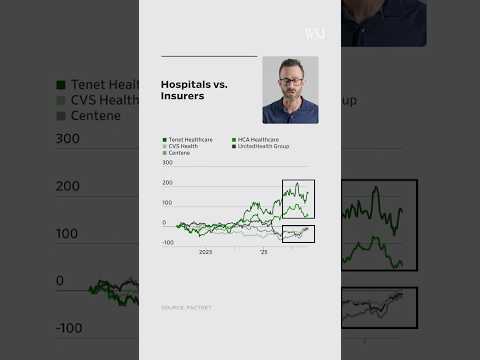
Why Health Insurers Are Winning and Hospitals Are Losing

Video thumbnail: Why Health Insurers Are Winning and Hospitals Are Losing
Jul 17, 20262m 8s video lengthThe Wall Street Journal

The Signal

Wall Street has reversed its sector preference from hospitals to health insurers, highlighting a volatile shift in healthcare economics. While hospitals recently thrived on pandemic-era demand and coverage expansion, insurers like UnitedHealth Group have now regained favor by tightening enrollment and cost metrics, even as hospital chains face mounting pressure from rising uninsured patient volumes.

The Case

  • UnitedHealth Group, the nation's largest health insurer, reported a blowout quarter after previously struggling with government reimbursement pressure on Medicare Advantage and surging medical costs that led to a stock collapse and a leadership change.0:07
  • The company's recent earnings beat was driven largely by a medical loss ratio—the percentage of premiums paid out for care—that came in nearly 2 percentage points lower than analysts projected.
  • UnitedHealth improved its financial standing by pulling back on Medicare Advantage enrollment, a strategic move that helped stabilize its performance during a period of broad insurer weakness.1:02

Hospital Sector Pressures

  • HCA, the hospital chain that served as the poster child for the industry's recent growth, recently cut its financial outlook as coverage dynamics deteriorated, causing its stock to fall sharply.
  • This downturn follows the expiration of federal Obamacare subsidies; as premiums rose, millions of Americans dropped out of coverage, leaving HCA to report an increase in uninsured patients who are currently receiving care for which the hospitals must now absorb the cost.1:34
  • While the shift from hospitals to insurers is clear in current market performance, it remains an open question whether this rotation represents a durable regime change or a temporary earnings swing for either sector.2:00

The 1 Minute Signal Take

The reversal in market sentiment highlights how sensitive healthcare margins are to shifting federal policy and enrollment discipline. Investors should watch whether UnitedHealth can maintain its improved medical loss ratio and if HCA's increased uninsured exposure signals a deeper, more permanent strain on hospital profitability.

Pro Analysis

Why It Matters

This sector rotation highlights the fragility of healthcare business models when they are heavily tethered to shifting government subsidies. When the state removes its financial cushion, the burden of uncompensated care shifts rapidly from the payer back to the provider, fundamentally altering the profit distribution of the entire industry.

Strategic Implications

For providers and insurance players, the strategy must shift from growth-at-all-costs to extreme discipline. Insurers who can successfully refine their enrollment mix to avoid high-cost clusters are currently being rewarded with massive valuation premiums. Hospitals, conversely, must brace for increased bad debt and potential credit pressure if the trend of shrinking exchange coverage persists.

Evidence & Hype Audit

The content represents standard financial reporting rhetoric. While the core findings (earnings results, subsidy status) are factual, the causal narratives (why Wall Street 'loves' or 'hates' a sector) are speculative. There is little quantitative depth, specifically regarding the localized impact of uninsured patients on HCA’s margins vs. national trends.

Counterarguments

The current 'insurer-led' win may be a temporary relief bounce rather than a structural change. Medicare Advantage margins remain under intense regulatory scrutiny, and a further downward swing in utilization rates could hit insurance companies just as hard as the recent surge in costs did.

Who Should Care

  • Institutional Investors: Looking for sector rotation signals.
  • Hospital Administrators: Managing liquidity in the face of rising uncompensated care.
  • Healthcare Policy Analysts: Evaluating the long-term impact of subsidy expiration on access and provider solvency.

What To Do Next

  • Verify future quarterly filings for sustained improvements in UnitedHealth’s medical loss ratio.
  • Review HCA’s latest guidance for specific updates on uninsured patient volume trends.
  • Analyze multi-quarter data on exchange coverage enrollment to identify if the current drop is a lasting trend.
  • Monitor any shifts in federal Medicare Advantage reimbursement policies that could alter the insurance sector’s cost basis.

Share this