
Channel: Nate Herk | AI Automation
100 Years of Artificial Intelligence Explained
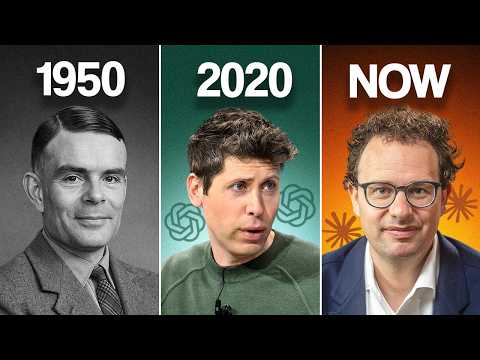
The Signal
This history of artificial intelligence tracks a recurring pivot from brittle, hand-coded symbolic rules to scalable, learned neural representations, punctuated by commercial cycles of hype and collapse. The central tension pits consumer-facing chat products against specialized developer tooling, with the latter currently driving heavy capital investment and durable power-user lock-in.
The Case
- Turing’s bombe, an electromechanical device designed to crack the Enigma code by testing keys against guessed phrases, helped the Allies read over 4,000 German messages per day by the war’s end.
- Minsky and Papert’s 1969 book, Perceptrons, used mathematical proofs to define hard limits on early neural systems, a critique that effectively halted government funding in the field and triggered an 'AI winter.'
- Expert systems like XCON saved Digital Equipment Corporation tens of millions of dollars annually by following thousands of hard-coded rules, yet they ultimately collapsed when cheaper $10,000 Sun workstations undercut the $70,000 specialized Lisp machines required to run them.
- AlexNet, a neural network built by Alex Krizhevsky in 2012, used the 1.2-million-image ImageNet dataset to beat the previous year’s best vision performance by 11 percentage points, proving that end-to-end learning outperformed hand-engineered features.
- DeepMind’s AlphaGo stunned professional champion Lee Sedol in 2016 with a novel move that required twelve minutes of deliberation to process, a moment the narrator interprets as evidence of the machine generating creative strategy beyond human theory.
- Anthropic’s Claude Code, a developer-centric tool capable of reading and editing files locally, reportedly reached over $1 billion in annual revenue by November 2025, six months after launch.
The 1 Minute Signal Take
The video delivers a crisp, well-structured historical sequence that effectively connects the technical bottlenecks of previous generations to the breakthroughs of the current era. While the narrator occasionally slips into hyperbolic claims about AI 'shortening the war' or 'creating new thoughts,' the underlying economic and technical history remains grounded. Watch it for the clear synthesis of how compute, data, and architectural shifts—specifically the transformer—conspired to create the current landscape.
Time saved:
Tags
Channel: Nate Herk | AI Automation