
Tag: Inflation
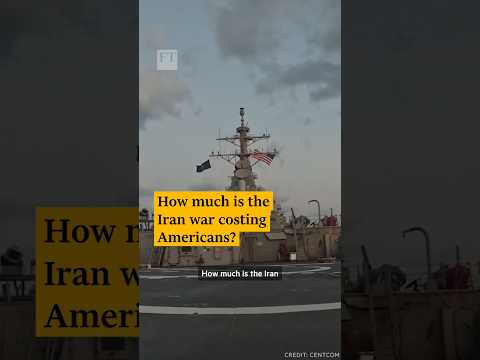
How much is the Iran war costing the Americans? | FT #shorts
The Signal
The war between Iran and the U.S. is presented as a widening financial burden for Americans that extends far beyond battlefield expenses. While direct military costs are estimated at $29 billion, the narrative argues that inflation fears and secondary economic disruptions have generated significantly higher costs for consumers. These include claimed losses from stalled Federal Reserve rate cuts, increased fuel prices, and surging freight rates, with the total impact potentially exceeding $270 billion.
The Case
- The Pentagon — the U.S. agency responsible for military operations — estimates initial war costs at $29 billion, primarily driven by the consumption of missiles and interceptors as the conflict continues.
- The narrator claims U.S. consumers have paid over $40 billion in additional fuel costs since the war began, though this figure is presented as a single estimate without methodological detail.
- Justin Wolers, a University of Michigan professor, estimates that Americans will lose $200 billion in economic output because the Federal Reserve could not implement a 0.5 percentage point interest rate cut due to inflation fears. This claim, while linked to Fed research, is presented as an assertion without independent validation.
- Higher interest rates resulting from these inflationary pressures are cited as the direct cause of more expensive mortgages and higher credit card bills for households.
- Transatlantic short-term freight rates have surged by more than half since the end of February, a trend attributed by the narrator to rising energy prices and the effective closure of the Strait of Hormuz.
- With the November midterm elections approaching, the video asserts that consumer financial pain leaves Trump’s political destiny on the line, though this remains a subjective political forecast.
The 1 Minute Signal Take
The video offers a coherent framework for how a regional conflict transmits costs to a domestic economy, but it relies on stacking speculative estimates to arrive at its $270 billion total. The causal chain connecting the war to specific Fed policy decisions and subsequent consumer debt is asserted rather than proven. Skip this video; the summary covers all critical estimates and provides the necessary context on the underlying causal assumptions.
Tags
Tag: Inflation