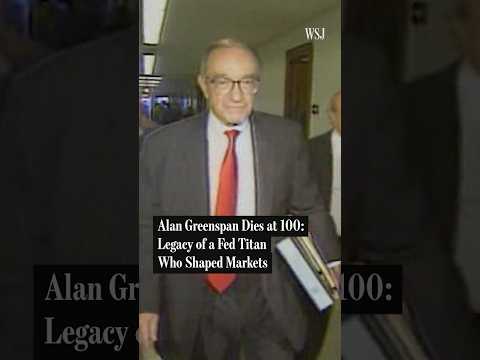
How Alan Greenspan Redefined the Fed

Video thumbnail: How Alan Greenspan Redefined the Fed
Jun 22, 20262m 21s video lengthThe Wall Street Journal

The Signal

Alan Greenspan, the Fed chair from 1987 to 2006, serves as the case study for the Federal Reserve’s enduring policy dilemmas. While historical consensus credits him with a successful 1994 preemptive rate hike, his tenure leaves behind unresolved, contested questions regarding if and when central banks should intervene to pop asset bubbles.

The Case

  • Greenspan’s 1994 record is often cited as a successful 'preemptive strike'—where the Fed doubled its short-term policy rate in 12 months—without triggering a recession, achieving what is known in economics as a 'soft landing.'0:39
  • The transcript links the Fed’s modern practice of narrating its decisions to a 1999 shift, asserting this change was driven by Greenspan’s desire to avoid repeating the 'scars of 1994,' though documentation for this causal connection remains thin.1:16
  • Greenspan’s late-1990s refusal to raise rates is framed as an alternative policy theory: he argued that an internet-driven productivity boom allowed faster growth without triggering inflation, a controversial bet that highlights the instability of relying on real-time data to gauge asset bubbles.0:58
  • Despite his 'irrational exuberance' speech serving as a historic warning against equity bubbles, the transcript notes that policymakers still lack a defined framework to identify when asset prices have 'unduly escalated' before they inevitably contract.1:32
  • Financial oversight remains an open challenge, with the Fed currently struggling to manage risks as high volumes of finance migrate outside the regulated banking system, a trend the transcript identifies as a primary, unresolved issue from the Greenspan era.1:52

The 1 Minute Signal Take

This video offers a concise, high-level survey of Greenspan’s legacy, but it is thin on evidence for its broader claims about how his specific 1990s decisions influence today’s central bank mechanics. It is useful as a primer on the unresolved policy debates surrounding bubble management, but skip it if you are looking for a rigorous, data-backed history of the Federal Reserve’s evolution.

Pro Analysis

Strategic Significance

  • The transcript highlights that institutional memory drives policy far more than abstract economic models; Fed behavior is often a reactive byproduct of past "scars."

Who Should Care

  • Market participants and policy analysts, because understanding the historical traumas that shaped the current Fed's communication style is essential for decoding their interest rate signals.

Contrarian Takeaway

  • Increased Fed transparency—the act of narrating decisions—may have been a defensive strategy to gain control over market sentiment, rather than an altruistic attempt to inform the public.
Time saved:17s

Share this

Tags