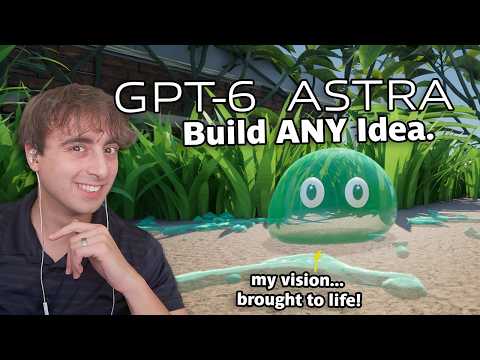
GPT-6 Astra is a Monster... That Still Needs You!

Video thumbnail: GPT-6 Astra is a Monster... That Still Needs You!
Sep 8, 202624m 28s video lengthMattVidPro

The Signal

GPT6 Astra, the latest frontier model from OpenAI, represents a substantial leap in 3D spatial reasoning and agentic game development. While it enables creators to build complex, authored systems without deep technical coding, the model remains limited by a lack of human experiential nuance, requiring heavy human iteration to reach high-quality results.

The Case

Capability and Human Steering

  • The speaker’s authored 3D jelly-slime game—built in Unreal Engine 5.8 using Codex and free Fab assets—showcased Astra’s strength in creative implementation, but succeeded only because the speaker provided persistent, corrective play-testing.6:15
  • An autonomous RPG world built without human guidance exposed significant flaws, including broken navigation, context-poor dialogue, and object flickering, illustrating that the model lacks inherent human-facing experiential intuition.8:34
  • The speaker identifies this lack of lived human experience as the primary barrier between current AI capabilities and polished, professional-grade output.17:27

Harness and Efficiency

  • Astra’s performance is heavily influenced by the agentic harness; the speaker favors Codeex over Claude Code, citing better orchestration of sub-agents and clearer task execution.18:24
  • While Astra is more capable, it is significantly more usage-intensive, burning through plan resets quickly and occasionally pausing mid-task to demand clarification from the user.21:09
  • Simple, routine tasks do not consistently showcase Astra’s edge over cheaper, leaner alternatives like Luna or Soul, suggesting that users should deploy Astra strategically for high-difficulty creative work.22:42

The 1 Minute Signal Take

Astra is a powerful creative engine, but it is not a hands-off replacement for human design. To derive value, treat the model as a highly skilled technician that requires an iterative, human-led director to bridge the gap between functional systems and coherent user experiences.

Pro Analysis

Why It Matters

Astra represents a shift in AI utility where the bottleneck is no longer the generation of syntax, but the curation of experience. This signals that the future of software development isn't just about 'coding' but about 'directing' AI models to simulate human-centric nuance.

Strategic Implications

Businesses should stop looking for 'autonomous' solutions and start training staff on 'AI orchestration.' The value-add in the future will be the ability to play-test and provide expert critique, effectively acting as an editor for the model’s outputs.

Evidence & Hype Audit

The content relies heavily on personal anecdote and curated demos. While the results shown are impressive, they are highly dependent on the speaker's specific workflow (Codeex + Unreal). There is a risk of selection bias where the 'best' demos are highlighted while 'failed' attempts are omitted.

Counterarguments

Critics might argue that the 'human experience' gap will disappear as models are trained on higher-quality gaming and UX data, rendering the need for human-in-the-loop iteration obsolete sooner than expected.

Who Should Care

  • Indie Developers: Massive force-multiplier for prototyping.
  • Product Managers: Essential for understanding how to steer development teams using AI.
  • AI Hobbyists: Must learn to prioritize harness choice as much as model choice.

What to Do Next

  • Implement a 'play-test first' loop for any AI-generated asset.
  • Compare output quality between Codeex and other harnesses for your specific use cases.
  • Audit your AI tool budget to account for higher resource consumption on complex agentic tasks.
  • Experiment with 'sub-agent' breakdowns for complex project architectures.
Time saved:21m 44s

Share this

Tags

Written by: 1 Minute Signal Editorial Team