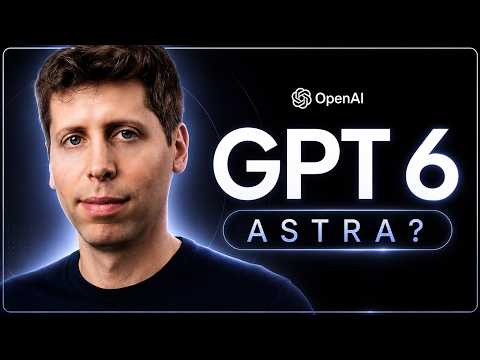
GPT 6 Astra in 11 mins!

Video thumbnail: GPT 6 Astra in 11 mins!
Sep 4, 202611m 27s video length1littlecoder

The Signal

OpenAI has released early access to "GPT6 Astra," a model drawing intense hype for reported benchmark dominance, including a 99% score on the ARC AGA3 reasoning test. While early demos suggest high proficiency in computer-use and multimodal tasks, the central tension remains whether these results represent a genuine leap toward AGI or merely incremental improvement.

The Case

Benchmark Performance and Hype

  • GPT6 Astra is fueling extreme claims of "solved" coding and AGI, driven largely by reports of the model hitting 99% on the ARC AGA3 benchmark, significantly outpacing the 30.2% mark of Claude Opus 5.0:30
  • Beyond general reasoning, the model reportedly scored nearly 97–98% on FrontierMath and 100% on ExploitBench, positioning it as a top-tier performer on specialized technical tasks.1:36
  • Access remains restricted to a very small group of companies and early users, which means most current assessments are based on anecdotal demos rather than independent verification.

Functional Capabilities

  • A recurring, widely reported strength is the model's autonomous computer-use, with early users claiming it can complete complex, delegated tasks—such as copying data between applications or filling out forms—without ongoing human supervision.5:47
  • The model shows strong multimodal integration, specifically in its ability to use Blender through tool-calling to generate 3D assets or house walkthroughs from a single entrance photograph.9:21
  • Despite these successes, the speaker’s assessment remains measured, noting that the model does not feel like an "astonishing" paradigm shift, but rather a highly competent, incremental evolution of existing frontier capabilities.10:16

The Interpretation Gap

  • The speaker explicitly rejects the notion that benchmark saturation implies sentience or AGI, arguing that high scores on existing tests measure specific aptitude rather than the emergence of general reasoning or consciousness.2:33
  • Hype surrounding the model’s writing quality and research potential is currently based on third-party reviews, such as those from Dan Shipper of the publication Every, and has not yet been subjected to broader, systematic testing.8:13

The 1 Minute Signal Take

Do not confuse high benchmark scores with the arrival of general intelligence, as current evidence for GPT6 Astra is confined to controlled, cherry-picked demos. Wait for wider access and independent testing on real-world engineering and data science workflows before accepting the narrative that this model represents a fundamental breakthrough.

Pro Analysis

Why It Matters

The release of GPT-6 Astra underscores the growing tension between rapid, synthetic performance gains on benchmarks and the tangible, generalized reliability required for actual industry disruption. As benchmarks become saturated, the field is forced to find new ways to differentiate 'intelligence' from pattern-matching efficiency.

Strategic Implications

For enterprises, the focus is shifting from 'can the model solve this task' to 'how reliably can the model chain these tasks autonomously.' The reported proficiency in computer-use suggests that AI is transitioning from an assistant to a delegable operator, which will drastically alter the labor requirements for routine digital tasks.

Evidence & Hype Audit

The content is heavily reliant on anecdotal reports and limited early-access demos. While the benchmark charts cited are specific, the methodology is opaque. The speaker maintains a healthy, necessary skepticism toward the 'AGI' narrative, though their own assessment is still based on second-hand information rather than personal validation.

Counterarguments

Critics of the 'incremental' perspective argue that if a model achieves near-perfect scores on previously 'impossible' benchmarks (like ARC-AGI), dismissing it as 'incremental' misses the exponential nature of intelligence scaling. A marginal improvement in capability can sometimes enable a non-linear breakthrough in application.

Who Should Care

  • Software Engineers: Pay attention to agentic task delegation and debugging capabilities.
  • Data Scientists: Watch for reproduction of the claimed 99% benchmark results.
  • Product Managers: Evaluate the model’s ability to handle complex UI/UX workflows.

What to Do Next

  • Await public API documentation to begin rigorous, independent testing.
  • Conduct side-by-side comparisons using your own existing agentic workflows.
  • Ignore the 'sentient' narrative and focus on the tool-calling precision.
  • Document error rates in long-context computer-use scenarios.
  • Compare the model’s 'humane' response style against your current preferred LLM.
Time saved:8m 4s

Share this

Tags

Written by: 1 Minute Signal Editorial Team