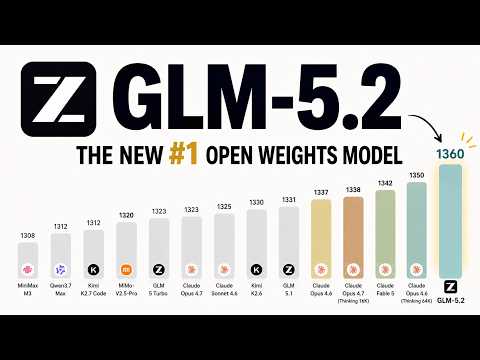
GLM 5.2 - The Top NEW Open Weights Model

Video thumbnail: GLM 5.2 - The Top NEW Open Weights Model
Jun 17, 202613m 22s video lengthSam Witteveen

The Signal

Z.ai has released open weights for its new GLM 5.2 model in both full and FP8 formats, signaling a shift in the accessible frontier. While benchmark tests from Artificial Analysis show a significant performance jump over GLM 5.1, the model’s performance relies heavily on token-intensive reasoning, creating a tension between its capability and its operating cost. The core trade-off is whether this model's lower per-token pricing justifies the potential latency and budget impacts of its long output chains compared to proprietary alternatives.

The Case

Model Capabilities and Benchmarks

  • GLM 5.2 demonstrates strong performance on long-horizon, coding, and design tasks according to benchmarks like Deep SWE and the speaker's own "Pelican test," positioning it as competitive with major frontier models.2:11
  • Despite these gains, the model sits behind top proprietary offerings like Anthropic Opus 4.8 and Fable 5 on several performance benchmarks, especially when those models move beyond standard testing environments.1:48
  • The model is notably strong in design and front-end generation, successfully producing complex layouts featuring animations and images that previously exceeded standard token caps.10:43

Economics and Deployment

  • The shift to open weights allows for flexible deployment via providers like OpenRouter, effectively moving the market toward pay-per-token models that may be more cost-effective than flat-rate subscription tiers.7:00
  • Current API pricing is set at $1.40 per million input tokens and $4.40 per million output tokens, which the speaker argues is substantially cheaper than equivalent proprietary models for many high-load use cases.7:33
  • Users must remain cautious about provider-specific privacy policies, as some third-party services used to access these open weights may retain prompts or utilize them for further model training.12:53

The 1 Minute Signal Take

You should evaluate GLM 5.2 as a viable, cost-effective substitute for frontier models if your workload is token-flexible, but you must benchmark it specifically against your own tasks to see if its long-reasoning style provides actual value or merely inflated costs. The model is a legitimate contender, but its true performance will vary significantly based on the serving provider's setup and your specific reasoning requirements.

Pro Analysis

Market Impact

The release of open weights for GLM 5.2 is a strategic disruptor. By providing the model weights, Z.ai lowers the barrier for developers to integrate top-tier reasoning into their own private infrastructure. This effectively forces proprietary labs to demonstrate value beyond mere availability, as they can no longer claim a monopoly on high-end intelligence.

Strategic Implications

Businesses now face a choice between the convenience of monolithic 'walled-garden' APIs and the granular control of self-hosted or provider-hosted open weights. The $1.40/$4.40 pricing model acts as a clear benchmark for other vendors to beat, likely exerting downward pressure on the entire market’s API pricing.

Hype vs. Evidence

The endorsement here is based on a mix of independent benchmarks from Artificial Analysis and observable tests. While the speaker’s enthusiasm is clear, they temper it with consistent reminders to evaluate performance for individual use cases. The claims regarding the model's capabilities are largely corroborated by its recent high rankings in competitive design arenas, making this less of an 'empty hype' scenario.

Counterarguments

Critics may point out that the model's reliance on 'long-chain' output is an inefficiency that will be quickly eclipsed by smarter, sparse-reasoning models. Additionally, if the model requires significantly more output tokens to achieve the same result as a competitor, the total fiscal cost may negate the lower base price.

Role-Specific Takeaways

  • Developers: Prioritize testing the model on long-loop agentic coding tasks.
  • CTOs/Architects: Review procurement strategies versus monthly SaaS tiers.
  • Privacy Officers: Carefully scope the data retention settings of the serving providers chosen for deployment.

Next Steps

  • Execute a comparative cost-analysis of your current API usage vs. GLM 5.2 rates.
  • Run a standard suite of your production prompts through OpenRouter.
  • Audit current provider confidentiality agreements for training data training clauses.
  • Profile token consumption for a representative subset of your tasks to gauge reasoning overhead.
Time saved:10m 1s

Share this

Tags