
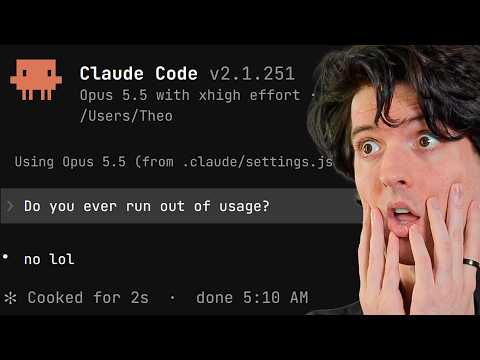
Why It Matters
This content shifts the perspective of LLM usage from a 'chat-based' assistant to a 'compute-intensive' engineering engine. It demonstrates that the constraint on AI progress is currently an infrastructure and alignment problem rather than a lack of 'raw intelligence.'
Strategic Implications
Businesses looking to leverage agentic workflows should look past the chat window. The real competitive advantage lies in developing 'verifiable reward' pipelines that allow agents to self-correct against a test suite or visual proxy without human intervention. This makes engineering processes highly scalable but creates a new dependency: your efficiency is now tethered to your compute and tool-stack flexibility.
Evidence & Hype Audit
While the speaker’s claims are self-reported and anecdotal, they are grounded in concrete operational data (e.g., specific build times, dollar spends, and commit counts). It is not shallow hype, but it is highly specific to a niche, high-budget workflow. It is not necessarily replicable by smaller teams without significant engineering overhead.
Counterarguments
Critics would argue that this 'compute-burning' approach is a brute-force methodology that ignores maintainability. By building custom tools like 'Lust' for a specific use case, the speaker is creating a technical debt mountain that only he can support. Furthermore, most production environments require reliability and stability, not the chaotic, non-deterministic iteration cycles favored here.
Who Should Care
- AI Research Engineers: For the R&D on RLVR (Reinforcement Learning with Verifiable Rewards).
- DevOps Architects: For managing high-burst, disposable compute infrastructure.
- Engineering Managers: For insights on how to 'manage' agents by surfacing and removing blockers.
What to Do Next
- Audit your current dev bottlenecks for 'tedious' tasks that could be automated via an agent.
- Implement a programmatic test suite that an agent can target as a pass/fail condition.
- Evaluate compute offloading tools to reduce build queue latency in CI loops.
- Use a secondary 'check-in' agent to monitor the primary agent's progress and identify stalled tasks.
- Experiment with snapshotting VMs to minimize state-rebuild time.
- Start small: don't build a new compiler; build a verifiable script that iterates on a single, well-defined function.