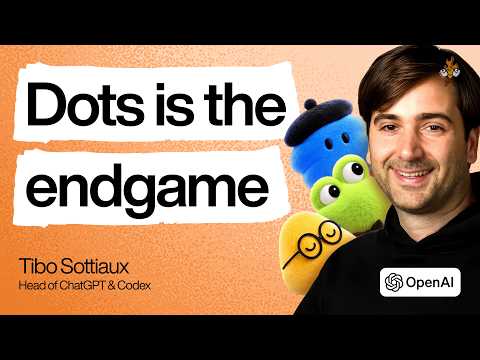
OpenAI’s Head of ChatGPT: We’re entering a new era of AI (again) | Tibo Sottiaux

Video thumbnail: OpenAI’s Head of ChatGPT: We’re entering a new era of AI (again) | Tibo Sottiaux
Oct 4, 202637m 23s video lengthLenny's Podcast

The Signal

OpenAI is shifting its product thesis from chat-based interfaces to persistent, cross-context agents that act on behalf of users. The company believes agents will soon dominate internet activity, prompting a move toward agent-scale infrastructure, unified product surfaces, and an open ecosystem where the model interface fades into the background of daily work.

The Case

The Agent-First Pivot

  • OpenAI is consolidating its product surfaces, such as merging Codex and ChatGPT work/consumer editions, to reduce user configuration fatigue and hide model-picking complexity.7:41
  • The company’s primary UX vision is the 'dot'—a persistent, memory-rich assistant that functions across any screen or client, learning user preferences over time to perform tasks 24/7.3:34
  • Executives claim that a majority of future internet actions will be performed by agents, which necessitates building systems for high-volume automated traffic rather than just human UI patterns.0:16

Ecosystem and Operational Architecture

  • To drive growth, OpenAI is betting on an open distribution strategy involving sign-in partnerships, plugin discovery, and revenue sharing for popular integrations like Notion and Figma.11:54
  • Safety is treated as an engineering constraint rather than a secondary policy, with significant compute dedicated to secondary monitoring, prompt-injection defenses, and hardware isolation for specialized agent roles.34:37
  • Internal development is described as highly bottom-up and autonomous, with a 'reset button' philosophy that prioritizes speed and rapid error correction over rigid approval hierarchies.27:36

Human Capital and Limitations

  • The internal workforce is heavily composed of ex-YC founders—reportedly over 120—who favor taste, user empathy, and rapid learning over traditional narrow specializations like fast typing.24:01
  • Many of the speaker’s claims, particularly the prediction of agent dominance and the effectiveness of current alignment strategies, remain forward-looking forecasts rather than verified market outcomes.30:57
  • While internal anecdotes suggest memory systems are already providing uncanny context awareness, the company is staging releases to manage safety risks, withholding some advanced capabilities to maintain quality control.15:23

The 1 Minute Signal Take

OpenAI is aggressively moving toward an ambient, agent-driven architecture that aims to eliminate the friction of manual AI interaction. While the strategy for persistent assistants and ecosystem-driven distribution is coherent, its success relies on unproven assumptions about agent-scale economics and the ability to maintain safety without sacrificing user utility.

Pro Analysis

Why It Matters

OpenAI is moving beyond the 'chatbot as a toy' phase. By centering their strategy on persistent, agentic 'Dots' that reside across all devices, they are attempting to become the primary operating system for the internet. If successful, this changes the power dynamic between users and web services, moving control to the AI agents that negotiate on our behalf.

Strategic Implications

  1. Platform Lock-in: By acting as the bridge to other tools (Notion, Figma, etc.), OpenAI is positioning themselves to capture the 'middle-man' tax of the internet.
  2. Shift in Talent: The focus on 'taste' and 'founder-mindset' over raw engineering speed suggests they are looking for product architects who can navigate the ambiguity of non-deterministic, learning-based systems.
  3. Hardware Integration: The mention of specialized dots running on local hardware (e.g., Mac Minis) suggests a future where the line between cloud and edge compute becomes increasingly blurred to optimize for latency and privacy.

Evidence & Hype Audit

This content is highly biased as it reflects internal product philosophy rather than independent market validation. While the operational examples (e.g., monitoring architectures) are plausible, the forecast that 'the majority of internet actions will be taken by agents' remains pure conjecture. The content is 'high-signal' regarding OpenAI's roadmap but should be viewed as a strategic sales pitch to developers and enterprise partners.

Counterarguments

Critics might argue that delegating critical internet actions to an agent increases the 'single point of failure' risk, and that the promise of 'simplifying' interfaces often just masks hidden complexity that can lead to catastrophic, unpredictable failure states.

Who Should Care

  • Product Managers: Need to prepare for an environment where your 'users' are increasingly automated bots.
  • DevOps/Backend Engineers: Need to prepare for spikes in non-human API traffic.
  • Entrepreneurs: Should look at where they can become a 'plug-in' to the OpenAI ecosystem.

What to do Next

  • Analyze your current workflows for repetitive, multi-step actions that could be delegated to an agent.
  • Audit your own software to determine how it would perform under unexpected, high-volume automated traffic.
  • Pivot hiring strategies to emphasize candidates who demonstrate high 'product taste' and adaptability rather than narrow domain expertise.
  • Review your personal digital footprint; if agents will know everything about your preferences, ensure your memory-integration settings are transparent.
Time saved:33m 34s

Share this

Tags

Written by: 1 Minute Signal Editorial Team