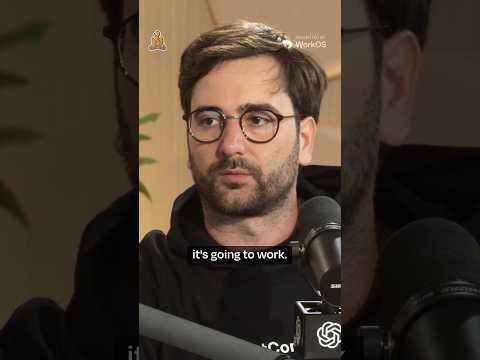
The Best AI Gets Out of the Way

Video thumbnail: The Best AI Gets Out of the Way
Oct 5, 202636s video lengthLenny's Podcast

The Signal

The speaker outlines a vision for "permanent active intelligence," an ambient AI model that replaces manual setup with continuous, cross-platform availability. The proposal pivots on shifting away from current "loop"-based workflows toward a system that automatically follows users across devices and contexts, though this remains an aspirational product philosophy rather than a demonstrated technical reality.

The Case

Core UX Philosophy

  • The speaker explicitly rejects current interaction models that require users to "set up and fiddle with" loops, favoring a system that requires zero manual configuration.0:00
  • The target experience is defined as "permanent active intelligence," designed to be ubiquitously available across any client or screen rather than siloed within a single application.

Functional Vision

  • The intelligence is envisioned to be context-aware, automatically surfacing in meeting rooms to record notes without explicit user triggering.
  • Workflow continuity is a primary goal, with the system expected to transition seamlessly from live meeting notes to follow-up tasks within email.
  • The model relies on a strict requirement for non-intrusiveness, asserting that the system must "get out of the way" when not actively needed by the user.0:28

The 1 Minute Signal Take

This vision prioritizes ambient, persistent presence over manual control, yet it lacks evidence regarding the feasibility of such deep cross-client continuity. For a potential user or developer, the shift represents a bet that frictionless automation will eventually outweigh the need for the manual configuration currently required by most agentic systems.

Pro Analysis

Why it Matters

This vision represents a fundamental shift in the UI/UX of artificial intelligence. It moves the technology from being a 'tool' to an 'environment.' For users, this implies that the bottleneck for productivity will move from how well they can operate AI software to how well the AI can infer their needs.

Strategic Implications

Companies building agentic AI are currently competing on model capability; however, the long-term winner will likely be the company that best solves 'context continuity.' If an assistant cannot follow a user from a physical meeting into an email thread, it remains a disconnected utility. The strategic moat is shifting from intelligence to integration.

Evidence & Hype Audit

The content is high-level vision, not a technical roadmap. It lacks evidence regarding security, privacy, or the feasibility of 'any client' interoperability. It is best interpreted as a design philosophy rather than a product specification.

Counterarguments

Critics might argue that 'permanent active intelligence' is a privacy nightmare. An AI that is always 'on' in meetings and email requires an unprecedented level of trust and data access. Furthermore, users often prefer manual control (the 'loops' the speaker criticizes) because it provides predictability and prevents the system from making unauthorized assumptions.

Who Should Care

  • Product Designers: For the focus on ambient vs. reactive UX.
  • Software Architects: For the requirement of cross-platform state synchronization.
  • General Users: To understand the likely direction of the tools they use daily.

What to do Next

  • Evaluate your current AI workflows for 'manual overhead.'
  • Map out where your context is currently lost when switching devices.
  • Monitor developments in 'agentic continuity' across major OS vendors.
  • Consider how much personal data you are willing to expose for 'seamless' integration.

Share this

Tags

Written by: 1 Minute Signal Editorial Team