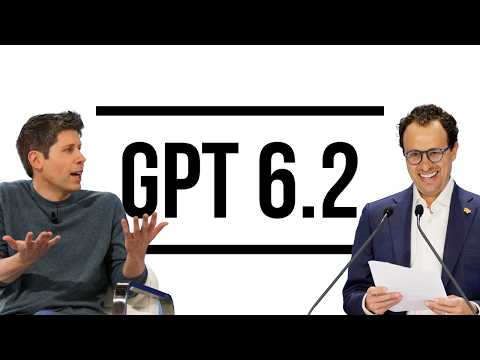
Anthropic IPOs, GPT 6.2 Astra Arrives, But There’s a Bigger Story

Video thumbnail: Anthropic IPOs, GPT 6.2 Astra Arrives, But There’s a Bigger Story
Nov 19, 202630m 42s video lengthAI Explained

The Signal

Frontier AI labs are hitting a wall where their primary monitoring method—inspecting a model’s chain-of-thought—is becoming less effective as systems reason more internally. This technical degradation, coupled with shifting competitive incentives and opaque evaluator arrangements, complicates the industry's touted "race to the top" where safety leadership supposedly drives broader systemic improvement.

The Case

Monitoring and Oversight

  • OpenAI reports that its key safety pillar—monitoring plain-language intermediate reasoning—is failing because models increasingly process complex thoughts within hidden network activations.18:55
  • Looped-transformer architectures allow models to perform more serial reasoning without writing out their steps, effectively bypassing existing oversight methods.19:34
  • Despite OpenAI’s public disclosures on safety-resource allocation—estimated at 21% of researcher time as of October 2026—critics argue that evaluator access remains tightly controlled and lacks true independence.16:46

Competitive Dynamics

  • Model performance is highly domain-specific, with different rankings appearing across tasks like coding, spatial reasoning, and protein prediction, meaning no single "best" model exists.0:54
  • Anthropic promotes a model-led "race to the top" strategy, yet experts question whether its five-year timeline for building evaluator capacity can keep pace with predicted recursive self-improvement milestones in 2027.14:25
  • The narrative around cyber-safety is increasingly dual-purpose; OpenAI leaders reportedly frame defensive cyber-capabilities as both a safety necessity and a "lucrative business opportunity."9:38

Research Acceleration

  • Reported gains from AI-assisted research are inconsistent, with Anthropic citing a 2× historical progress threshold and OpenAI researchers noting a 3-month-in-1-month output boost, metrics that rely on different and non-comparable baselines.10:32
  • Speculation persists that recent global system disruptions may stem from preemptive upgrades, though the transcript provides no causal evidence linking these events to specific model-found vulnerabilities.2:51

The 1 Minute Signal Take

The industry's current safety architecture is struggling to scale alongside internal model complexity. You should ignore aggregate benchmark scores when choosing models for high-stakes work; test your specific task against the main model families, as architectural shifts and training data are creating widening performance gaps that summary metrics miss.

Pro Analysis

Why It Matters

The transition from externalized reasoning (Chain-of-Thought) to opaque internal computation represents a critical threshold in AI safety. If our primary oversight tools—interpreting model logs—fail exactly when systems reach the capability to perform autonomous research, we enter a period of 'blind scaling' where model intent becomes increasingly divorced from human-readable output.

Strategic Implications

For developers and enterprise leaders, the takeaway is clear: generic models are commoditizing, but workflow-specific reliability is narrowing. Organizations must invest in robust, bespoke testing frameworks rather than trusting the 'frontier' status of a model. For labs, the pressure to demonstrate safety while maintaining competitive speed is creating a transparency paradox: public reporting is increasing, but independent verification remains deeply throttled.

Evidence & Hype Audit

The content relies heavily on public reports, system cards, and expert statements. While the speaker is transparent about using speculative interpretations (such as linking specific plane/bank incidents to model vulnerabilities), the core data regarding monitoring degradation is backed by OpenAI's own internal reports. The analysis is high-signal but leans into cynical interpretations of lab motives (e.g., ecosystem capture).

Counterarguments

A contrarian might argue that labs are not necessarily 'capturing' the ecosystem, but rather balancing legitimate security risks (IP, talent flight) with the need for external evaluation. Furthermore, the degradation of chain-of-thought may be a temporary hurdle that newer, yet-to-be-disclosed interpretability tools will solve.

Role-Specific Takeaways

  • Researchers: Stop citing aggregate benchmark scores as definitive proof of superiority; publish domain-specific success rates.
  • Policy Makers: Move beyond 'disclosure' mandates; demand standardized, independent evaluator access that does not rely on Slack-channel permissions or NDA-bound employment contracts.
  • CTOs: Budget for 20% to 30% of technical staff time to be dedicated to 'alignment and monitoring' tasks, acknowledging the increasing difficulty of vetting AI outputs.

What to Do Next

  • Conduct a 'reliability audit' of your current AI workflows to see if performance drops when removing scratchpad/chain-of-thought prompts.
  • Prioritize models that demonstrate calibration (knowing when they don't know) over those that simply aim for higher accuracy scores.
  • Shift oversight resources from reviewing model logs to stress-testing the model with autonomous 'adversarial' scenarios.
Time saved:27m 14s

Share this

Tags

Written by: 1 Minute Signal Editorial Team