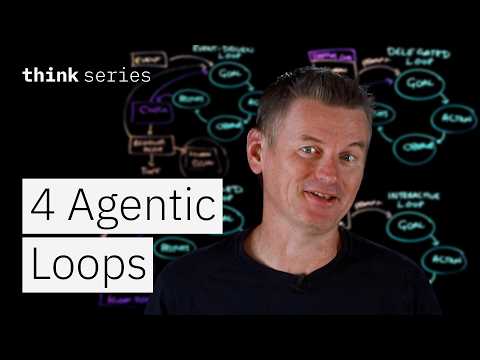
4 Types of AI Agent Loops: From Human-Led to Autonomous

Video thumbnail: 4 Types of AI Agent Loops: From Human-Led to Autonomous
Nov 19, 20269m 8s video lengthIBM Technology

The Signal

This video defines a four-tier framework for agentic AI architectures based on how a system initiates tasks and validates completion. It categorizes designs from fully human-interactive to event-driven autonomous loops. The central tension lies in the trade-off between automating repetitive judgment and retaining human control for edge cases or ill-defined goals.

The Case

Architectural Loop Designs

  • The Interactive loop requires a human to set the goal and manually validate every turn, making it ideal for tasks with fuzzy finish lines but creating a significant scaling bottleneck.
  • The Delegated loop allows a human to define a specific stopping condition—such as a green build status—which an AI check then monitors, automating completion judgment while keeping human review for the final result.3:35
  • The Scheduled loop automates the initiation of delegated runs using a clock, which is suited for recurring maintenance tasks like library updates, though a human must still review each resulting output.5:23
  • The Event-driven design is the most autonomous in this framework: an event triggers the run, an AI evaluates completion, and a secondary reviewer agent handles routine approvals, reserving human oversight only for uncertain exceptions.6:37

Critical Design Limitations

  • The taxonomy is a conceptual model proposed by the speaker rather than an established technical standard; the speaker provides no comparative evidence regarding the reliability, cost, or performance of these designs.0:04
  • In the event-driven model, "they will effectively only see exceptions at this point" remains the defining constraint, as the reliance on a reviewer agent and AI-powered checks introduces potential failure points not addressed by the speaker.8:12

The 1 Minute Signal Take

This framework provides a useful mental model for deciding where to insert human versus automated checkpoints in agentic workflows. When implementing these, prioritize defining the stopping condition and exception-handling logic, as the safety of the system depends more on these parameters than on the initiation trigger.

Pro Analysis

Why It Matters

Understanding agentic loops transforms AI from a query-response tool into an automated workforce. Most users are stuck in interactive loops, which effectively limits AI utility to single-turn tasks. Shifting toward delegated or event-driven models is the prerequisite for building agents that actually save labor rather than just shifting the burden of supervision.

Strategic Implications

The shift toward event-driven autonomy suggests that the 'agentic' future is actually a future of 'multi-agent systems.' The need for a separate reviewer agent confirms that a single model is rarely sufficient for high-stakes automation; you need a worker and a checker.

Evidence & Hype Audit

This content is high-signal conceptual framing rather than data-driven research. It is free from manipulative hype but lacks empirical validation. It presents a logical taxonomy that works well for design, but it does not account for the high rate of failure or 'hallucination' that often occurs when agents judge their own completion status.

Counterarguments

The framework assumes that an 'AI check' is reliable enough to stop a loop. In practice, LLM-based verification often mirrors the fallibility of the primary model. Relying on an AI to judge its own completion may lead to 'infinite loop' scenarios where the agent is blind to its own failure, increasing costs and resource consumption.

Who Should Care

  • Software Engineers: To automate repetitive library and CI/CD tasks.
  • Product Managers: To map out how agentic features should interact with end-users.
  • AI Operations Teams: To design the 'reviewer' hierarchies that prevent erroneous agent output from reaching production.

What To Do Next

  • Audit your current AI workflows to see if you are performing manual judgments that could be codified into a boolean 'check' function.
  • Identify one recurring, low-stakes task and replace your manual trigger with a clock or event-based trigger.
  • Build a simple validation script or separate agent prompt that acts as a 'done' check.
  • Establish an escalation pathway that routes 'ambiguous' AI outputs to your team's existing manual review queue.
Time saved:5m 51s

Share this

Tags

Written by: 1 Minute Signal Editorial Team