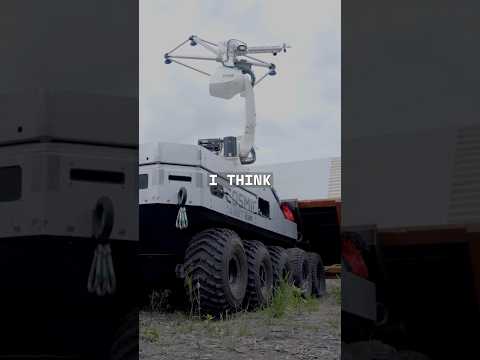
Autonomous construction on Earth and beyond

Video thumbnail: Autonomous construction on Earth and beyond
Sep 24, 20262m 24s video lengthY Combinator

The Signal

Fossma Robotics is attempting to scale construction autonomy on Earth to eventually fund off-world infrastructure. By focusing on labor-intensive tasks for solar farms and data centers, the company aims to prove its technology through immediate commercial deployment, operating under the stated belief that Earth-first revenue is the only viable path to Mars.

The Case

Operational Traction

  • Fossma claims early market validation through three prior system iterations, including the installation of 11,000 solar panels on large-scale projects.
  • The company has transitioned to a "production version" of its machinery and reports signing a contract with the largest construction firm in the United States.1:28
  • Founder James, a mechanical engineer with four years of prior experience in autonomous heavy equipment, asserts that current manual construction methods are the primary bottleneck for energy and data infrastructure.0:16

Strategic Roadmap

  • The company’s 10-year strategy relies on deploying tens of thousands of units on Earth to generate the data and capital required for lunar and Martian expansion.1:45
  • To maintain product fit, the Fossma team employs an immersive operating model, living on-site with customers—such as at a 2,000-acre solar farm in South Texas—for months at a time to build trust and observe manual workflow gaps.2:02
  • While the company leverages SpaceX’s industrial scale as a benchmark for its own ambitions, claims regarding the severity of construction labor shortages and the necessity of autonomy for off-world settlement remain internal assertions rather than demonstrated facts.

The 1 Minute Signal Take

Fossma is betting that it can bypass the theoretical phase of space construction by proving itself as a utility-grade provider for Earth’s most demanding energy projects. The company’s operational credibility hinges entirely on its reported solar installation data, making it a critical metric to watch as they attempt to scale.

Pro Analysis

Why It Matters

Construction is one of the last major global industries to see deep-stack automation. Because infrastructure is the physical prerequisite for data centers and renewable energy, even incremental improvements in automation efficiency have massive downstream impacts on the speed of technological and energy-sector growth.

Strategic Implications

Fossma's decision to focus on solar farms is astute; these sites are repetitive, highly standardized, and suffer from extreme labor shortages. By conquering these 'easier' environments first, they are de-risking the complex, unstructured terrain of future Moon/Mars missions.

Evidence & Hype Audit

This content leans heavily on the founder's narrative. While the claim of 11,000 installed panels suggests real engineering progress, the assertions regarding the severity of labor bottlenecks and the necessity of autonomy for off-world settlement are speculative. The roadmap is ambitious but lacks public financial or technical performance verification.

Counterarguments

Critics might argue that construction is inherently too site-specific for standardized robotics. If Fossma’s machines cannot adapt to unpredictable soil conditions or weather-driven site changes, their fleet scaling plans may stall before reaching the tens of thousands required for the long-term roadmap.

Who Should Care

  • Infrastructure Investors: Look at the unit economics of these solar-installation machines versus manual labor costs.
  • Space-Tech Founders: Observe the 'Earth-first' scaling model as a viable alternative to pure R&D-heavy space startups.
  • Construction Executives: Evaluate if offloading rote tasks to robotics can alleviate the current labor-shortage bottleneck.

What To Do Next

  • Verify the specific tasks Fossma is targeting that currently lack existing equipment solutions.
  • Monitor the public disclosure of the unnamed top-tier construction firm's partnership metrics.
  • Evaluate the reliability of the robotic systems when deployed in environments outside of standardized, flat solar farms.
  • Assess whether the company’s manufacturing capacity can realistically scale to tens of thousands of units within the decade.

Share this

Tags

Written by: 1 Minute Signal Editorial Team