
Why It Matters
As AI-driven software development accelerates, the bottleneck has shifted from writing code to ensuring that code actually fulfills business intent. The industry is reaching a point where syntax-based safety is becoming a commodity, making the 'correctness' of business logic the primary new frontier for software quality and security.
Strategic Implications
Companies that rely solely on automated agents without implementing rule-aware verification layers risk technical debt and security gaps that scanners will never catch. This necessitates a move toward 'process-based' scanning, where tools must interpret intent rather than just identifying malformed syntax.
Evidence & Hype Audit
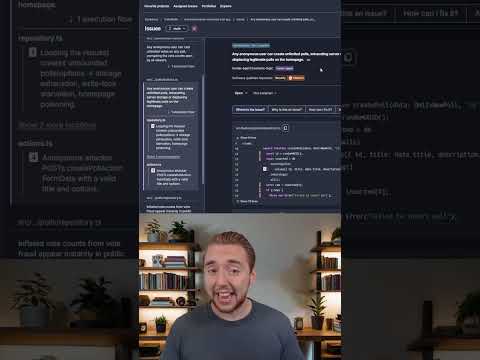
This content is clearly high-level product marketing. While the technical diagnosis (business logic vs. syntax) is sound, the specific efficacy of Hunter Agent's 'prover' capability is asserted rather than demonstrated. Viewers should be cautious of the 'works out everything for you' framing, as business rules are notoriously difficult to generalize without significant manual configuration of those referenced playbooks.
Counterarguments
Critics might argue that inferring 'intended' business rules via an AI agent is prone to hallucinations or misinterpretations, potentially creating as many false positives as it resolves. Additionally, maintaining 'playbooks' for large, evolving codebases could become a significant administrative overhead.
Role-Specific Takeaways
- Engineering Leads: Move beyond static analysis; look for tools that can model system intent.
- Security Teams: Acknowledge that your existing toolset is likely blind to modern agent-introduced logic errors.
- Developers: Use agents for speed, but rely on deterministic verification layers to catch policy breaches.
What to do next
- Review your current CI/CD pipeline for gaps in business-logic verification.
- Assess if your security tools can identify custom access control or authentication failures.
- Test your current agent workflows against a known set of business-rule constraints.
- Evaluate the feasibility of moving to an agent-based verification model.
- Verify if your team has the capability to define the 'rules' that any scanning agent must follow.